Marine underwriters are expected to reach a decision on a vessel in minutes. Price it, accept it, or decline it - and be ready to defend that call if a claim arises. That timeframe hasn't changed. What has changed is how much data now sits behind every one of those decisions.
Incident history. Machinery condition. Dry dock status. Inspection records. Ownership and manager detail. Behavioural signals like spoofing or ship-to-ship transfers. None of this lives in one place. It's spread across class societies, flag registries, port state control feeds, inspection databases, and a handful of internal spreadsheets built to plug the gaps.
The result: underwriters are losing 2-4 hours every week manually stitching together a picture that should already exist. Checking vessels one by one. Re-reading incident reports that take real expertise to interpret. And still, more often than not, reaching a decision with less confidence than the risk deserves.
Where the time actually goes
The problem isn't a lack of data - most underwriters have access to more vessel information today than ever before. The problem is what it takes to turn that data into a decision.
- Vessel-by-vessel bottlenecks - there's rarely a way to screen multiple vessels at once, so fleet-level or portfolio-level decisions become slow, repetitive, and labour-intensive.
- Hard-to-interpret reports - incident, class, and P&I reports are dense and inconsistent in format, and take time to synthesise into a clear risk judgement even for an experienced underwriter.
- Hidden accumulation risk - correlated exposure across a fleet, a region, or a counterparty is difficult to see when every vessel is checked in isolation.
- A weak audit trail - when a claim comes in, the rationale behind the original decision often has to be reconstructed from notes, memory, and whatever was saved at the time.
- High false positives - without context, flagged vessels trigger unnecessary re-checks, adding hours to a book of business that was never actually high-risk.
Each of these is manageable on its own. Together, across a book of hundreds or thousands of vessels, they add up to a structural drag on how fast - and how confidently - underwriters can work.
What a faster, more defensible process looks like
The fix isn't more data. It's one trusted, consolidated view of the data underwriters already have a right to expect - built around how a pre-bind decision actually gets made.
That means dry dock visibility, so operational red flags surface earlier rather than after the fact. A centralised operational screening panel that brings incidents, inspections, detentions, and readiness indicators together, instead of requiring a manual tour through multiple systems. Multi-vessel port call filtering, so fleet-wide exposure to ports of concern is visible instantly rather than vessel by vessel. And incident and casualty data that's been human-verified - not just aggregated from public sources - so the judgement behind it can be trusted and defended.
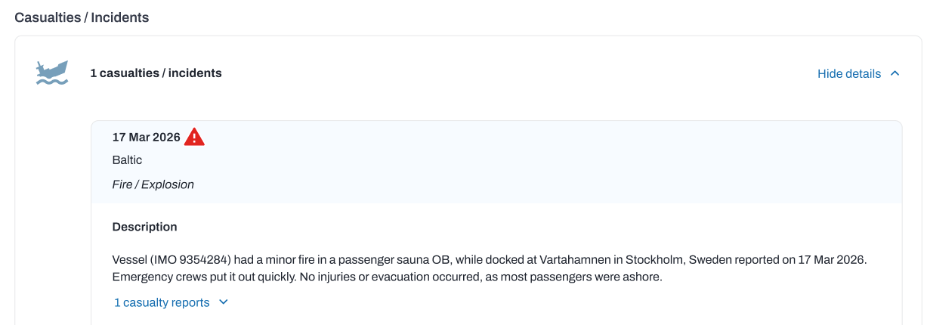
This is the thinking behind Vessel Due Diligence: a decision workbench, not another data feed, designed to consolidate fragmented operational risk signals into one place so underwriters can reach faster, more consistent decisions - and stand behind them, at bind and at claim.
The cost of standing still
Fragmented data doesn't just cost time. It costs competitiveness on low-risk business that takes too long to clear, consistency across a book of business assessed by different underwriters under different pressures, and confidence in exactly the decisions that are hardest to unwind once made.
Underwriting will always require judgement. It shouldn't also require hours of manual assembly just to get to the point where that judgement can be applied.
Ready to see it for yourself? Request a demo of Vessel Due Diligence today!
.png)