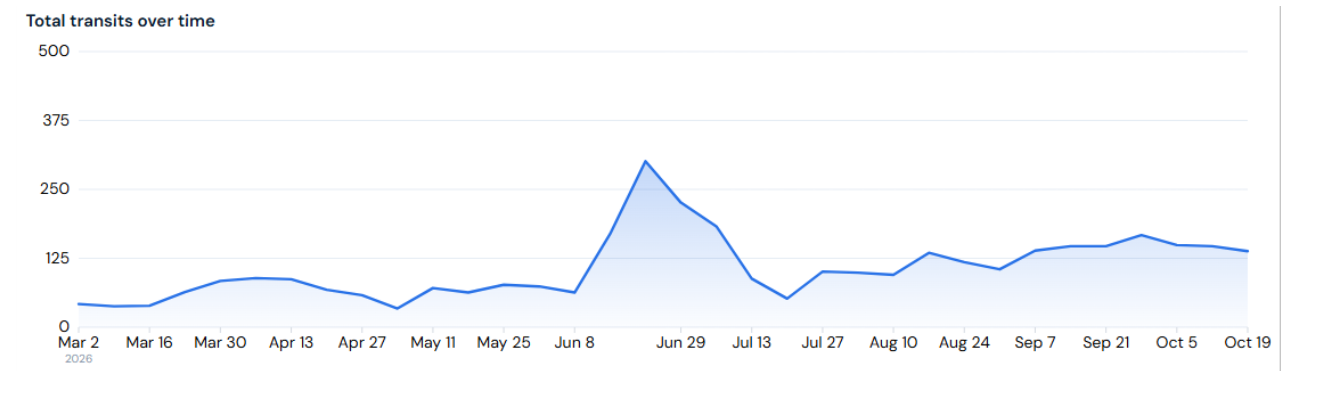
Non-Iranian-linked Hormuz transits 19-25 October (most recent complete data):
- Total transits: 116 vs 124 (12-18 October)
- Eastbound transits: 43 vs 67
- Westbound transits: 73 vs 57
- Tanker and gas carrier transits: 95 vs 99
Executive summary
Hormuz traffic slows during intense period of Iranian attacks but has not plummeted. Over the three-week period from 5-25 October the weekly average of non-Iranian-linked transits, defined by ownership, trading exposure or sanctions status, was 121. The weekly average over the previous three weeks (14 September to 4 October) was 132. The drop-in activity is being driven by fewer vessels exiting the Middle East Gulf, with inbound transits maintaining relatively normal levels.
Key takeaways
Crude transits dip but there is no shuttle shutdown. From 12 to 25 October there have been 153 voyages of non-Iranian-linked crude tankers into and out of the Middle East Gulf, compared to 174 over the two weeks prior. While this is a decrease of 12%, inbound transits have not seen a sustained fall. At least 44 crude tankers sailed into the MEG between 19 to 25 October, up from 32 the previous week. The ‘normal’ average is about 41.
Bulk carrier traffic posts small gains. Preliminary data for 26 October to 1 November shows at least 21 Hormuz transits of non-Iranian-linked bulk carriers, bringing the total over the past three weeks to a minimum of 58 vessels. This is an 18% increase on the three-week period prior. In recent months some bulkers that originally were moving Iranian cargoes deceptively have swapped to other MEG markets.
Shadow fleet is playing an increasingly important role in Middle East Gulf exports. Former Iranian, Russian and Venezuelan trading tonnage is being drawn into MEG exports as operators seek vessels willing to accept the region’s heightened risk. More than 50 non-sanctioned tankers and gas carriers have swapped to compliant MEG trades since the start of the conflict, which includes 15 VLCCs.
Source: Lloyd’s List Intelligence Strait of Hormuz Transit Monitor
Security summary
UK Maritime Trade Operations says 144 events have been reported since the start of the conflict to end of October. In approximately 75% of cases vessels have been able to continue their voyage.
US Central Command continues to enforce its blockade of Iranian ports. Centcom says 144 merchant vessels have been redirected.
Risk outlook
Questions remain on how US midterm elections could impact Hormuz crisis. US President Donald Trump said he would not launch a big escalation against Iran before the midterm elections, but with the vote over Trump is free to change tact. Analysts say a severe military escalation that hits the shuttle system hard would initially push up tanker rates before a sharp fall when available cargoes drop. In terms of traffic, the fleet trading out of the MEG has proven to be flexible throughout the crisis, including now in what is certainly the most violent period. Should the situation worsen, it is possible for players to abandon the market, but it is unclear what is that tipping point.
Publication schedule
We are altering the publication schedule for the Strait of Hormuz Brief. It will now be published fortnightly on Thursdays, with the next edition on 19 November.
If you missed the Week in Maritime Intelligence webinar, register to watch the briefing on demand. To register for every week in the series, complete this form.
* Lloyd’s List Intelligence defines a tanker as being part of the Shadow Fleet if it engages in one or more deceptive shipping practices indicating that it is involved in the facilitation of sanctioned oil cargoes from Iran, Russia or Venezuela. Or it is sanctioned for participation in sanctioned oil trades or is sanctioned for links to a company that is sanctioned for facilitating the export of sanctioned oil. Or it participates in a cargo delivery where at some point over the course of the delivery one party in the chain engages in one or more deceptive shipping practices.
Lloyd’s List defines an LPG carrier as being part of the LPG Shadow Fleet if it engages in one or more deceptive shipping practices, or if it is sanctioned by the US, UK or EU.
This briefing was compiled by the Maritime Intelligence Unit
All analysis focuses on cargo-carrying vessels over 10,000 dwt