Suez Canal
- October 2026: 1,338 transits/125.6m dwt
- September 2026: 1,228 transits/106.3m dwt
- October traffic up 63% year on year (YoY), down 34% on pre-Houthi crisis levels
Bab el Mandeb
- October 2026: 1,363 transits/112.3m dwt
- September 2026: 1,215 transits/ 95.7m dwt
- October traffic up 43% YoY, down 46% on pre-Houthi crisis levels
Executive summary
Suez traffic hits a post-crisis high for the fifth consecutive month. There were 1,338 transits in October equivalent to 125.6m dwt, an increase of 18% on September’s dwt figures. The average number of monthly transits from January to November 2023, before the mass exodus from the Red Sea, was 2009, or 182m in tonnage terms.
Activity in the Red Sea’s southern chokepoint grew 17% in October. Traffic through the Bab el Mandeb totalled 1,363 transits last month, or 112.3m dwt. This is an increase of 17% month on month for dwt. Movements through the strait have returned to the elevated levels recorded after the start of the crisis in the Middle East Gulf, but it is containerships rather than crude tankers driving the recovery.
Key takeaways
Distorted tanker trades push Suez crude volumes above pre-crisis levels. The pre-crisis monthly average for crude tanker traffic was 44.35m dwt. In October crude traffic reached 47.13m dwt. This is not a return to pre-crisis trading patterns, though. The October surge in Suez tanker transits coincided with a sharp rebound in Yanbu crude loadings, which in turn boosted northbound crude trade. The other big driver of tanker activity is Russian crude moving south towards India, coupled with ballast tanker returns north. More than a third of large crude tanker passages through Suez involved sanctioned ships.
Evergreen joins accelerating liner return to Suez, ending its near three-year absence from the route. The Taiwanese carrier is the last Ocean Alliance partner to resume Suez transits. The capacity released by carriers returning to Suez coupled with slowing demand risks pushing the trade towards oversupply.
Return of mainline containerships continues to gather pace, even as renewed Houthi attacks underline the security risks confronting carriers restoring Red Sea services. Some 426 boxship transits were made in October, up from 315 in September and 230 in October 2025. Approximately half of all containership transits are “dark”, with vessel-tracking systems disabled, highlighting the tension between carriers’ commercial return to the shorter routing and continuing concern over security.
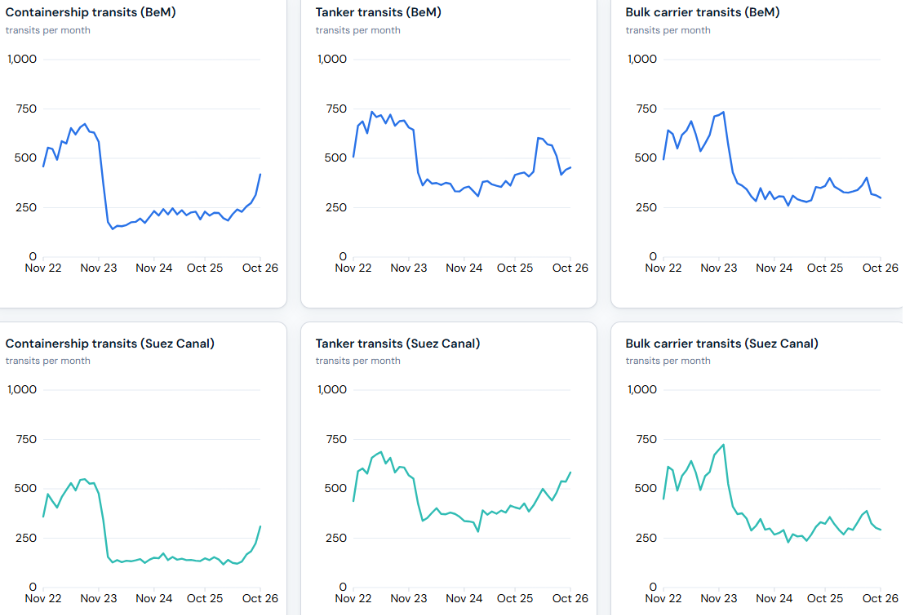
Source: Lloyd’s List Intelligence Red Sea Transit Monitor
Security summary
Threat to shipping remains substantial in Red Sea, but there have been no recent incidents reported. The UK Maritime Trade Operations says there has been an increase in reporting from vessels of interactions with claimed Yemeni Authorities, but there have been no attacks since August 24.
Suspicious activity in the Bab el Mandeb Strait was reported on 6 November. A large explosion was observed in the strait, but the cause and circumstances are unknown.
EU governments have failed to reinforce their Red Sea naval mission despite repeated warnings that Operation Aspides lacks sufficient warships to meet growing demand from commercial shipping. EUNAVFOR Aspides communicated its force requirements to EU member states, but there is no indication that any additional contributions have been made.
Risk outlook
October numbers are clearest indicator of significant recovery to Red Sea traffic, but the situation is not “normal”. The unprecedented amount of crude tonnage moving through Suez is due to geopolitical disruptions, while containerships are the only market segment growing at a pace where reaching pre-crisis levels at both chokepoints seems achievable in the near term. Still, these boxships are behaving in unconventional ways, opting to operate offline in the area because of ongoing security concerns.
The renewed tensions in the Red Sea have had a limited impact on the wider shipping industry, with the market adjusting accordingly. As such, the Red Sea Brief will now be published fortnightly unless there is a change in circumstances.
If you missed the Week in Maritime Intelligence webinar, register to watch the briefing on demand. To register for every week in the series, complete this form.
This brief was compiled by the Maritime Intelligence Unit
All analysis focuses on cargo-carrying vessels over 10,000 dwt