Why Shipborne AIS Strengthens Offshore Maritime Intelligence
When people think about AIS data collection, they typically think of two sources: terrestrial receivers on land and satellites in orbit.
Both play a critical role in modern vessel tracking.
Terrestrial AIS provides exceptionally high-frequency updates around coastlines, ports and inland waterways. Satellite AIS extends visibility across the world's oceans, enabling vessels to be tracked far beyond the reach of shore-based infrastructure.
However, each collection method has different strengths.
This is why shipborne AIS has become such an important component of today's maritime intelligence ecosystem.
The Foundation: Proprietary Terrestrial AIS
Terrestrial AIS remains the backbone of vessel tracking around coastlines, ports and major waterways.
Through our proprietary network of shore-based AIS receivers, Lloyd's List Intelligence captures high-frequency vessel movements where maritime activity is often at its most concentrated. This provides detailed visibility into port calls, coastal trading patterns and vessel movements close to shore.
However, terrestrial AIS is constrained by the range of VHF radio transmissions. As vessels move further offshore, additional collection methods become increasingly important.
Extending Visibility with Satellite AIS
By collecting AIS transmissions from low Earth orbit, satellites provide global reach and enable vessel tracking far beyond the limits of terrestrial infrastructure. However, collecting AIS transmissions from space presents unique challenges. Due to the distance between vessel and satellite, weaker signals can be harder to detect, while each satellite must simultaneously observe AIS transmissions across a vast geographic footprint.
In busy shipping regions, this can increase the complexity of message detection and decoding.
This is why a multi-source approach matters.
The Offshore Advantage of Shipborne AIS
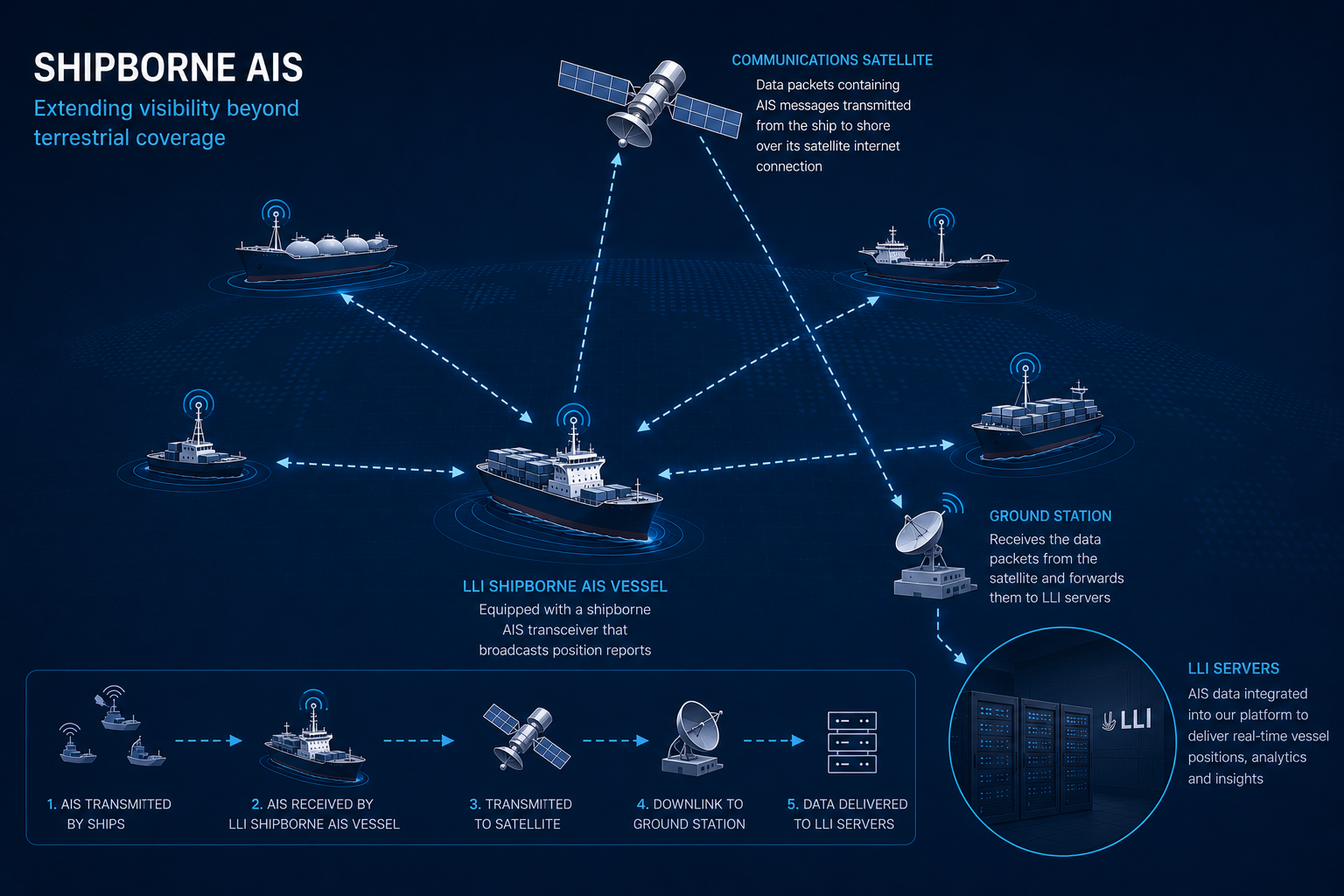
Shipborne AIS provides the powerful middle layer of collection.
Thousands of participating vessels act as mobile AIS collection points, continuously receiving transmissions from nearby ships and securely transmitting that data ashore through modern communications networks.
Unlike terrestrial AIS, shipborne collection is not limited to coastal coverage. Unlike satellite AIS, shipborne receivers collect signals from a much smaller local area, closer to where transmissions originate.
This creates a distributed offshore collection network that moves with global trade flows, shipping lanes and vessel activity.
Where ships operate, the network operates.
Every participating vessel contributes additional observations, expands offshore visibility and increases collection resilience across some of the world's most important maritime regions.
Regions such as the Red Sea, Strait of Malacca and South China Sea are among the world's most strategically important maritime corridors, carrying substantial volumes of global trade. By collecting AIS data directly from vessels operating within these regions, shipborne AIS adds an important layer of offshore intelligence that complements terrestrial and satellite collection.
Stronger Together
The real strength of maritime intelligence does not come from a single collection method.
It comes from combining multiple collection sources to create the most complete picture possible.
At Lloyd's List Intelligence, our AIS SeaOrbis service combines:
- Our proprietary, global terrestrial AIS network
- Global satellite AIS collection
- Thousands of shipborne AIS collection vessels
Each source contributes different strengths.
Terrestrial AIS delivers depth and frequency around coastlines and ports. Satellite AIS provides mid-ocean reach. Shipborne AIS strengthens offshore intelligence by collecting data directly from vessels operating at sea.
Together, these complementary layers create a more complete, resilient and trusted view of global vessel activity.
Building Confidence in Maritime Intelligence
As organisations increasingly rely on vessel data to support trade analysis, sanctions compliance, risk assessment and supply chain visibility, confidence in the underlying intelligence has never been more important.
That confidence comes from combining the right collection methods in the right places.
By integrating proprietary terrestrial AIS, satellite AIS and an extensive shipborne AIS network comprising thousands of vessels, Lloyd's List Intelligence continues to deliver the comprehensive maritime intelligence that customers depend on every day.
In a world where global trade relies on accurate vessel tracking, the strength of maritime intelligence is increasingly determined not by a single source of data, but by the power of the collection network behind it.
To learn more about our AIS tracking capabilities, explore AIS SeaOrbis.