
Geopolitical risk is reshaping the terms of global shipping. At this year’s Lloyd’s List Intelligence New York City Outlook Forum, more than 100 executives from shipping, energy, commodity trading, and financial risk and compliance gathered to consider what that means for global trade.
Held at The Lotos Club on 21 October 2026, the forum explored three pressing questions: how the Strait of Hormuz crisis could develop, why resilience is taking precedence over the rules-based trade order— and at what cost— and why sanctions compliance is becoming a “web of concerns”.
Geopolitical risk has always shaped shipping, and barriers have always created opportunities. But the scale of today’s disruption— and the cargo and capital at stake— raises the stakes. This recap explores the forum’s discussion. Panelists spoke under the Chatham House Rule, so not all comments are attributed.
The presentation deck is available to download and you can also listen to some of the event via the podcast – links to both are at the end of this post.
Key takeaways from the 2026 NYC Outlook Forum
• Strait of Hormuz: Iran is rationing attacks to keep risk high while preserving ammunition; US naval protection could end quickly, and the market cannot price that uncertainty. September 2026 saw a post-conflict record 493 transits and the conflict's worst week of attacks at the same time.
• Global trade: Freedom of navigation is eroding in Hormuz, the Bab el Mandeb and the Black Sea, and shipping has traded rules-based efficiency for resilience, which means more ships, higher rates and inflation risk.
• Sanctions compliance: US, UK and EU regimes are no longer as aligned, policy can change "on a dime", and red flags like AIS gaps and spoofing now appear on compliant vessels too. Of 1,478 active shadow-fleet tankers tracked by Lloyd's List Intelligence at the end of September 2026, 427 are not themselves sanctioned.
Who spoke at the 2026 NYC Outlook Forum
Richard Meade, Lloyd's List Editor in Chief and Special Advisor to the Maritime Intelligence Unit, moderated. The Outlook presentation was given by Richard Meade and Tomer Raanan, Senior Maritime Intelligence Analyst, Lloyd's List Intelligence.
Panel 1: Geopolitics and maritime security
Noam Raydan, Senior Research Fellow, The Washington Institute for Near East Policy; Joshua Tallis, Research Program Director, Ally and Partner Security Affairs, CNA Corporation; Claire O'Neil McCleskey, Founding Partner, Clarity Compliance Consulting
Fireside chat: Maritime connectivity and the changing world order
Jan Hoffmann, Global Lead for Maritime Transport and Ports, The World Bank
Panel 2: Security, risk, sanctions and compliance
Claire Grunewald, Founding Partner, Clarity Compliance Consulting; Manny Levitt, International Trade Attorney, Holland & Knight LLP; Tomer Raanan, Senior Maritime Intelligence Analyst, Lloyd's List Intelligence
How could the Strait of Hormuz crisis develop?
The view on the Hormuz crisis: it could get worse.
The market has already seen how fast the strait can close. In one week in July 2026, total vessel transits through the Strait of Hormuz fell 52%, from 82 (July 13–19) to 39 (July 20–26), according to Lloyd's List Intelligence MIU tracking. Outbound journeys fell 46% and inbound 61%. Lloyd's List Intelligence analysts validate each transit, including dark transits that standard AIS searches miss.
Traffic has since recovered, under fire. Lloyd's List Intelligence's latest validated count puts non-Iranian-linked vessel transits at 493 or more in September 2026, the highest monthly total since the war began.
Inbound movements reached 237, up 48% from July. In the same weeks the attacks grew worse. At least 13 tankers and gas carriers were attacked in the week of September 28, the most in any week of the conflict. Since the conflict began, 93 commercial vessels have been targeted, including 29 crude tankers and 17 product tankers. Weekly counts are on the MIU Strait of Hormuz dashboard. Source: MIU Risk Briefing, Q4 2026.
Iran is hitting only a few ships a day, one speaker said, "to keep the risks very high along the Omani route" while it saves ammunition for an expected next round of war with the US and Israel. Iran's aim is to "win the narrative war", not to maximize attacks.
The US military can defend the Omani route indefinitely, in theory. Two caveats:
1. "US air cover, as we've seen, is far from impenetrable."
2. The deployment carries "future readiness costs" elsewhere. "This is the crisis of the day, and there will be future crises – potentially in the Asia-Pacific."
US military support for Hormuz shipping could therefore end quickly, and "it's hard for the market to price that uncertainty".
The consensus: shipping will keep serving Hormuz even if attacks increase. The industry has adapted. "There are plenty more ships, and a seemingly endless stream of seafarers willing to take danger money to do this."
Iran has learned the value of its geography. "The Iranians are now aware of the amount of influence they have over the oil market," one panelist said. "There's no way of putting the cat back in the bag."
Why is the rules-based order for global trade breaking down?
Freedom of navigation, the principle beneath global seaborne trade, is eroding at three chokepoints at once. Iranian attacks in the Strait of Hormuz, the Houthi threat in the Bab el Mandeb, and Russian and Ukrainian strikes in the Black Sea point to the same problem.
Navigational risk now sits on top of friction from rising trade barriers. As "trade is becoming geopolitically conditional", ship movements are less efficient. Effective capacity falls and rates rise. "You cannot trade all ships to all places. More ships are needed to carry the same volume of global cargo."
"We are in a period," one speaker said, "where shipping has essentially exchanged the efficiency of a rules-based order built out of Bretton Woods onward for resilience and security, which comes with chaos."
That chaos has a price. "As a consequence of that friction, there will be so much additional cost to the global economy, and the average consumer or politician is not aware of the long-term risk that poses. We simply don't have the experience in recent memory to articulate the implications for inflation."
Why is maritime sanctions compliance getting harder?
The Hormuz crisis and the Russia-Ukraine war are also changing the US sanctions regime. Two examples: the Trump administration's recent allowance for US imports of Russian diesel and its effort to move some shadow tankers from "the bad guy fleet to the good guy fleet" as one speaker put it.
Sanctions are meant to change behaviour. These changes, however, are being made "in the context of an energy crisis, not a policy goal".
Policy revisions come fast, and compliance programmes struggle to keep up. "Things can change very much on a dime."
Three further complications:
• Automatic Identification System (AIS) gaps and spoofing are no longer shadow-fleet signals alone. AIS manipulation tactics that shadow vessels used to evade sanctions are now used by compliant ships for safety. Meanwhile, spoofing itself has evolved, from switching off AIS to fabricating whole voyages that look normal.
• Some vessels have "flipped" from sanctioned trades to mainstream service. "You have some ships… lifting sanctioned barrels, and now they are using the very same practices to move compliant barrels." Lloyd's List Intelligence counts at least 34 crude, product and chemical tankers, including eight VLCCs, and seven LPG carriers that have switched to mainstream cargoes since the Middle East Gulf crisis began. Almost all are non-sanctioned.
• Russia is moving its shadow fleet from concealment to state protection. Since July 2026, 86 shadow-fleet tankers have joined the Russian flag register. That complicates further the grounds some Western authorities have used for boarding and inspection.
The result is a "web of concerns" for compliance teams, arriving alongside the Hormuz crisis and the retreat from the rules-based trade order.
Download the presentation
The slide deck from the forum includes the Outlook presentation by Richard Meade and Tomer Raanan: Hormuz and Red Sea transit data, the shadow fleet count, Russian reflagging, and case studies of fabricated voyages. It is available as a PowerPoint file.
Download the NYC Outlook Forum 2026 presentation (PPTX)
The Hormuz, shadow fleet and reflagging figures in this post come from the Maritime Intelligence Unit (MIU) Risk Briefing for Q4 2026. The briefing also covers the Caspian corridor and the Red Sea recovery.
Download the MIU Risk Briefing Q4 2026 (PDF)
Listen to Part One of the New York City Outlook Forum podcast via the Lloyd’s List website or app.
Listen to the podcast here (free to listen)
Event photos
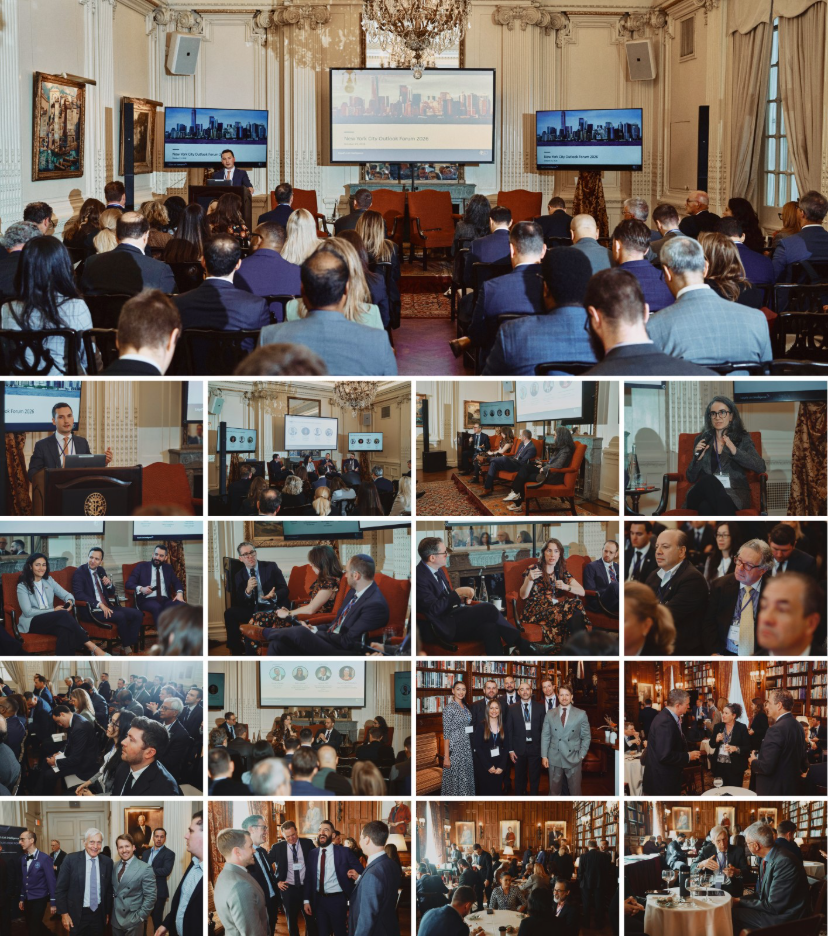
Photos from the Lloyd's List Intelligence New YorkOutlook Forum, The Lotos Club, October 21, 2026.
What should maritime, trading and compliance teams do now?
The forum points to four responses:
1. Price Hormuz protection as temporary. US naval cover for the Omani route could end quickly. Charter and insurance decisions should assume it has a shelf life.
2. Plan for lower fleet efficiency. Geopolitically conditional trade means more tonne-miles per cargo. Budget for higher rates and longer voyages, not a spike.
3. Screen counterparties, not only vessels. US firms avoid Russian-origin business directly. Exposure arrives through non-US counterparties that do not.
4. Re-weight compliance red flags. AIS gaps, spoofing and flipped vessels no longer map cleanly to the shadow fleet. Read vessel behaviour alongside ownership history, voyage pattern and licensing status before treating it as a sanctions signal.
The screening gap is measurable. Lloyd's List Intelligence tracked 1,478 active shadow-fleet tankers at the end of September 2026: 1,051 sanctioned and 427 not sanctioned, as presented at the forum by Richard Meade and Tomer Raanan. Sanctions-list screening alone misses the 427. Ownership is the other blind spot: 755 sanctioned shadow-fleet vessels have no identifiable beneficial owner.
Methodology: Lloyd's List Intelligence classifies a tanker as part of the shadow fleet when it has engaged in one or more deceptive shipping practices indicating involvement in sanctioned oil trades from Iran,Russia or Venezuela during the previous two years; is sanctioned for facilitating sanctioned oil exports or for links to a company involved in those exports; or participates in a cargo delivery where a party in the delivery chain meets those conditions. See the ShadowFleet methodology.
Frequently asked questions
What is the Lloyd's List Intelligence NYC Outlook Forum?
An invite-only executive forum held each year in New York for leaders in shipping, energy and commodity trading, and financial risk and compliance. The2026 forum was held October 21 at The Lotos Club, with more than 100 attendees.
What were the main topics at the 2026 forum?
TheStrait of Hormuz crisis, the erosion of freedom of navigation and the rules-based trade order, and the growing complexity of US, UK and EU sanctions compliance.
Can I download the presentation?
Yes. The full slide deck is available as a PowerPoint file in the Download the presentation section above.
Why are the speakers not named?
The forum ran under the Chatham House rule. Quotes may be used but not attributed.
Stay ahead of the next flashpoint
To see how these tools support your risk, compliance or trading teams, contact our Americas team.