.avif)
In the opaque world of maritime trade, transparency is critical. Yet, as sanctions tighten and illicit trade routes evolve, vessels are finding new ways to disguise their movements. One of the most troubling trends is AIS spoofing- the deliberate falsification of a ship’s location data.
For years, vessels engaged in illicit activity simply switched off their AIS transponders, creating gaps in reporting. But those gaps quickly became red flags. Spoofing, by contrast, allows ships to “hide in plain sight,” transmitting false signals that suggest a vessel is somewhere it is not. The data keeps flowing, yet it cannot be trusted.

The Market Problem: Trust Eroded by Deceptive Signals
Spoofing is harder to detect than silence. Unless verified by satellite imagery or eyewitness reports, falsified AIS signals often blend into the stream of legitimate data. Illicit actors exploit this loophole to move contraband, bypass sanctions, and conceal illicit trade.
For shipping companies, insurers, regulators, and financiers, the consequences are severe. They risk relying on data that misrepresents reality, leading to compliance failures, financial loss, and reputational damage.
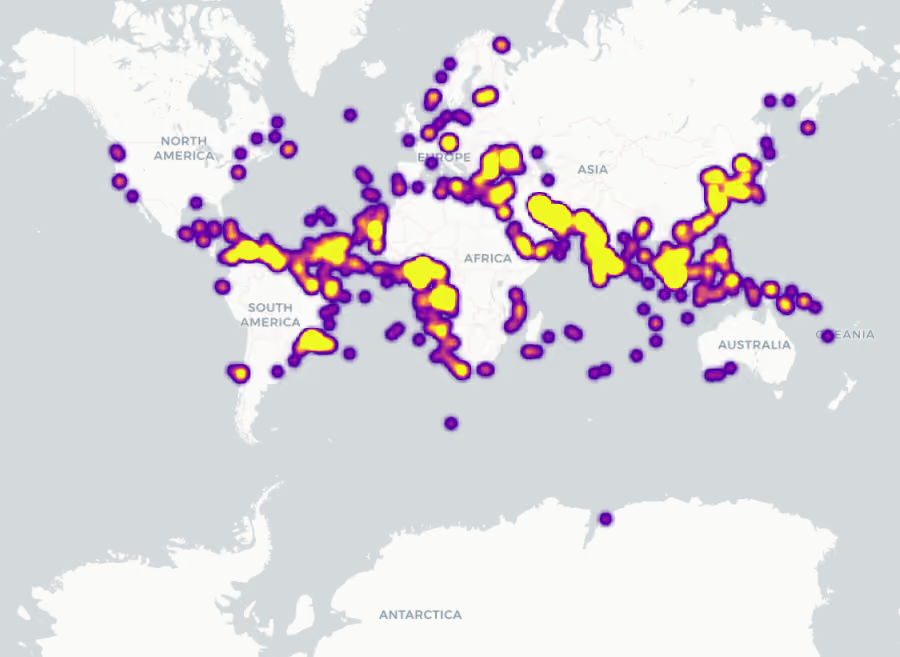
Our Approach: Data Science Meets Maritime Domain Expertise
To confront this challenge, our team has combined rule-based models, machine learning, and our proprietary AIS receiver network. By cleaning and analysing vessel voyages, we’ve trained models to recognize patterns that strongly suggest spoofing.
- Rule-based detection: Identifying impossible behaviours, such as a ship remaining perfectly stationary in open waters or transmitting the same speed and course values for hours.
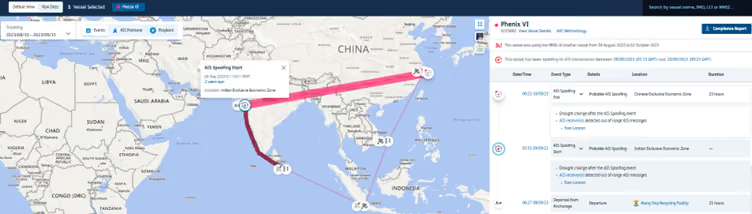
- AIS station corroboration: Comparing vessel-reported positions with ground-truth AIS receiver data to identify “out of range” transmissions.
- Machine Learning models: Both supervised and unsupervised techniques learn from verified spoofing events to uncover more nuanced patterns.
To ensure accuracy, detections require agreement between multiple models—significantly reducing false positives while boosting confidence in the results.

Evolution of the Solution
Our initial release brought strong coverage of spoofing activity, and followed closely by rapid evolutions to our methods:
- Improved messaging and risk scoring for clearer customer insights.
- Noise reduction to minimise false positives.
- Feedback loops that retrain models based on new spoofing events, client feedback, and Lloyd’s List insights.
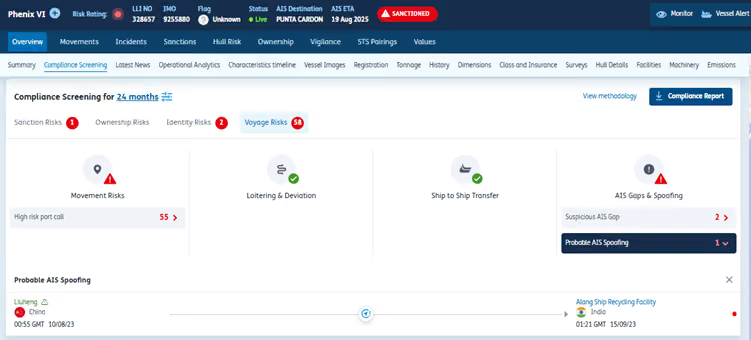
- Explainability so clients can see why an event was flagged (“AIS station out of range,” “impossible stationary behaviour,” etc.).
The result is a continually improving system, one that keeps pace with the ever-changing face of deceptive shipping practices.

Delivering Customer Value
For our clients, this solution brings more than just alerts. It provides:
- Risk scoring for vessels engaged in suspicious behaviour, enabling smarter business decisions.
- Evidence to challenge claims, for example when a Bill of Lading cites a port call that was never seen in AIS.
- Confidence and clarity thanks to transparent detection methods and explainable outputs.
- Investigative power, supporting compliance teams, insurers, and regulators in uncovering illicit trade.
By pairing advanced data science with domain expertise, we provide insights that most organisations could not achieve alone.
The Road Ahead
AIS spoofing will not stand still. New techniques emerge as sanctions shift, and geopolitical conflicts unfold. That’s why our approach is not static: it evolves through continuous research, client collaboration, and innovation in machine learning.
Our mission is to ensure that deceptive shipping practices never go undetected, and that our clients have the clarity and confidence they need to make high-stakes decisions.

Conclusion: Turning Insight into Action
Spoofing is one of the most sophisticated challenges facing maritime risk and compliance teams today. But with the right combination of technology, expertise, and ground-truth data, it can be detected, flagged, and acted upon.
Advanced Compliance suite brings these capabilities to life- delivering explainable, data-driven insights that help clients stay ahead of deceptive shipping practices.
Learn more about how Advanced Compliance can enhance your risk evaluation and protect your organisation against the hidden risks of AIS spoofing.
.png)