A spotlight on the Hengdeli Deyesion International v MV ‘Haralambos’
In maritime markets, who ultimately controls a vessel is rarely a simple question. Ownership can sit behind layers of corporate structures, chartering arrangements, managers, family interests and commercial relationships. For counterparties, insurers, financiers, legal teams and compliance professionals, that opacity creates real risk: if you cannot confidently understand who is connected to a ship, you cannot fully assess exposure.
The South African Supreme Court of Appeal’s August 2026 ruling in Hengdeli Deyesion International Shipping Limited v MV ‘Haralambos’ and Others is a timely reminder of the value of high-quality vessel intelligence in establishing those connections.
The dispute originated from a chartering agreement involving the MV Argentina. Its charterer, Hengdeli Deyesion International Shipping Limited, began arbitration proceedings against the vessel’s owner, Iron Pasha Incorporated, for a claim of approximately US$5 million. Seeking security for that claim, Hengdeli obtained the arrest of another vessel, the MV Haralambos, in South Africa.
The key question was whether the two vessels were connected through common control. Hengdeli argued that the companies owning the Argentina and the Haralambos were ultimately controlled by the same interests. After the KwaZulu-Natal High Court initially rejected that case and lifted the arrest, the Supreme Court of Appeal reversed the decision, concluding that the evidence, taken together, was sufficient to establish common control.
In reaching that conclusion, the Court considered multiple sources of information, including company filings, shipping register entries, an email describing the vessels as sister ships, and a Lloyd’s List Intelligence Seasearcher report identifying the Vafias Group as the beneficial owner of the Haralambos.
Connecting the dots on ownership and control
The judgment illustrates the value that credible commercial vessel intelligence can have when combined with other sources to build a clearer picture of ownership and control. As reported in Lloyd’s List, Seasearcher was described by the judge as
“the most widely used and accepted commercial vessel-tracing tool in the maritime industry.”
For maritime businesses, this matters because commercial intelligence is no longer just a research input. It is increasingly part of how risk is assessed, challenged and evidenced. When commercial relationships are complex, fragmented or difficult to trace, organisations need information that is timely, connected and defensible.
How do you understand who stands behind the vessel?
The ability to identify and understand relevant ownership connections can strengthen due diligence and give compliance teams greater confidence in their decisions.
This broader view is essential when the question is not simply “what is this vessel?” but “who stands behind it, who is connected to it, and what does that mean for my decision?”
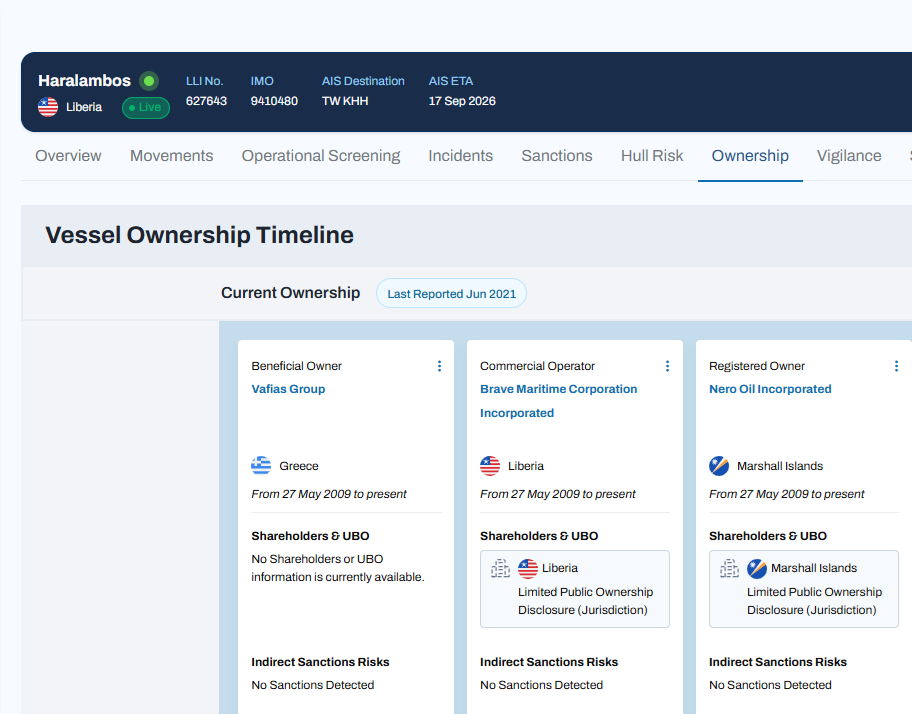
From a data perspective, the strength lies not in a single ownership field, but in the connections between records. A vessel can have separate registered owners, beneficial owners, managers and third-party operators. Connecting these entities across vessels and corporate structures can reveal shared addresses, common directors, recurring management relationships and wider fleet associations that may not be apparent when each record is viewed in isolation.
The Haralambos ruling shows the importance of bringing these multiple signals together to uncover relationships that may not be immediately apparent.
A trusted source when certainty is hard to find
For organisations exposed to maritime risk, Seasearcher provides trusted intelligence to help them see beyond the name on the stern and understand who, and what, sits behind a vessel.
Where a compliance investigation requires greater depth, Seasearcher Advanced Compliance enables teams to explore multi-level ownership structures, identify shareholders and ultimate beneficial owners, and assess sanctions exposure across the ownership chain. By automatically aggregating sanctioned ownership against OFAC’s 50% Rule, it helps teams move beyond name-only screening and build a more complete, defensible view of who stands behind a vessel.
For users that need a deeper understanding of a specific company, they can also request a Counterparty Risk report, combining ownership and vessel intelligence with analyst-led research into the company’s ownership and structure, history, operations, recent developments and financial position.
Talk to our team today to learn more.
.png)