Non-Iranian-linked Hormuz October 2026:
- Total transits: 550 vs 504 (September 2026)
- Eastbound transits: 260 vs 257
- Westbound transits: 290 vs 247
- Tanker and gas carrier transits: 442 vs 419
Executive summary
October was the busiest month for Hormuz traffic since start of conflict. Non-Iranian-linked transits, defined by ownership, trading exposure or sanctions status, drove growth last month, with 550 movements through the strait.
Bulkers boosted Iranian activity, which grew nearly 30% month on month. A total of 58 bulk carriers transited Hormuz in October to call at Iranian ports, up from 35 in September. Total trackable Iranian traffic totalled 106, compared to 83 the previous month. Movements of product tankers and LPG carriers remained stable with 19 and 16 transits respectively.
Key takeaways
Non-Iranian traffic volumes held throughout October despite a sharp deterioration in the security situation. Transits totalled at least 121 during the last week of October, with another 121 recorded from 19-25 October, 125 between 12-18 October and 123 from 5 -11 October. There were at least 321 transits of crude tankers in the four weeks to 1 November, compared to 329 in September.
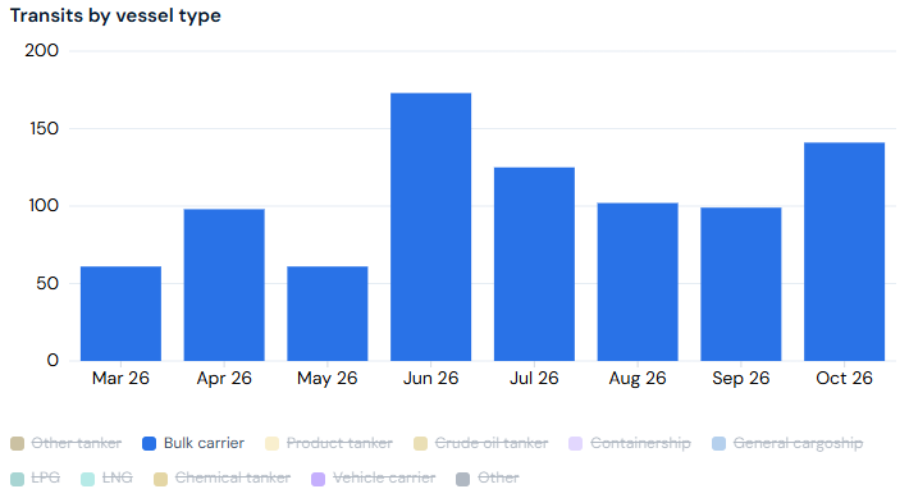
Middle East Gulf bulker traffic hits conflict-era high. A total of 45 bulk carriers were tracked entering the MEG last month, the highest number of inbound movements since the war broke out in February. Non-Iranian-linked bulker activity has been steadily increasing since August with a total of 84 transits in October, the highest monthly figure outside of the brief Memorandum of Understanding period (when traffic surged as ships exited the MEG). China-headquartered companies are playing an increasingly prominent role in this trade, accounting for 29% of transits in October.
Source: Lloyd’s List Intelligence Strait of Hormuz Transit Monitor
Security summary
UK Maritime Trade Operations says 163 events have been reported since the start of the conflict to 11 November. There were seven attacks reported between 5-11 November. Attacks have continued this week, including an incident involving a liquefied petroleum gas carrier that has since been engulfed in flames. Since mid-August 10% of all vessels reported as attacked have been confirmed lost or sunk.
US forces strike bulker for allegedly breaching Washington’s blockade of Iran. US Central Command says 147 commercial vessels have been redirected, and five ships disabled.
Risk outlook
US push to rehabilitate sanctioned tankers faces a slow deal-by-deal process. At least five companies are actively discussing specific transactions with Washington, including proposals to acquire very large crude carriers for deployment in and around the Strait of Hormuz. Despite the potentially large pool of sanctioned tonnage available, people directly involved in the process say the number of vessels that can realistically pass the necessary legal, technical and political tests is likely to be small. The initiative partly originated with companies approaching US regulators arguing that a selected fraction of the shadow fleet could be brought back into legitimate trading, adding capacity at a time of exceptionally high freight costs.
Publication schedule
We are altering the publication schedule for the Strait of Hormuz Brief. It will now be published fortnightly on Thursdays, with the next edition on 3 December.
If you missed the Week in Maritime Intelligence webinar, register to watch the briefing on demand. To register for every week in the series, complete this form.
* Lloyd’s List Intelligence defines a tanker as being part of the Shadow Fleet if it engages in one or more deceptive shipping practices indicating that it is involved in the facilitation of sanctioned oil cargoes from Iran, Russia or Venezuela. Or it is sanctioned for participation in sanctioned oil trades or is sanctioned for links to a company that is sanctioned for facilitating the export of sanctioned oil. Or it participates in a cargo delivery where at some point over the course of the delivery one party in the chain engages in one or more deceptive shipping practices.
Lloyd’s List defines an LPG carrier as being part of the LPG Shadow Fleet if it engages in one or more deceptive shipping practices, or if it is sanctioned by the US, UK or EU.
This briefing was compiled by the Maritime Intelligence Unit
All analysis focuses on cargo-carrying vessels over 10,000 dwt