Suez Canal
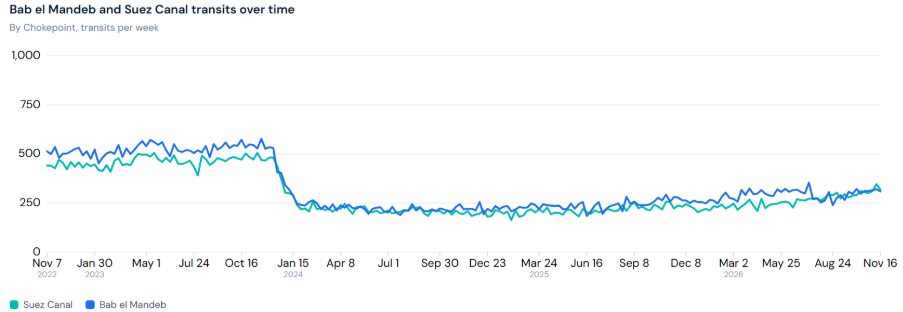
- 16-22 November: 318 transits/30.1m dwt
- Decrease of 8% week on week, and 31% higher than weekly November 2025 average
- In tonnage terms, volumes are down 28% on pre-Houthi crisis levels
Bab el Mandeb
- 9-15 November (last complete week due to dark transit activity): 320 transits/28.4m dwt
- Increase of 2% week on week, and 15% higher than weekly November 2025 average
- In tonnage terms, volumes are down 38% on pre-Houthi crisis levels
Executive summary
Suez transits hold steady at elevated volumes. Although activity fell week on week, driven by a 35% drop in bulker traffic, transits through the Red Sea’s northern chokepoint topped 30m dwt for the third consecutive week.
Bab el Mandeb traffic continues to rally with a seven-week growth streak. Transits from 9-15 November, the last complete week due to dark activity, hit 320 (28.4m dwt). Containerships and tankers are providing the biggest lift to traffic.
Key takeaways
Containership capacity through Suez breaks new weekly record. A total of 984,782 worth of TEU capacity sailed through Suez between 16-22 November, just 24% less than pre-crisis levels. The weekly average in November 2023, before the mass exodus from the Red Sea, was 1.3m teu capacity.
Dark activity off Saudi Arabia’s coast skyrockets after Houthi’s declaration of a ‘maritime embargo’ in July. The average monthly number of gaps in Automatic Identification System transmissions (vessel-tracking data) that were longer than 24 hours was 28. This figure topped 230 in September and October. Not every gap in AIS transmissions equates to an arrival to Saudi Arabia, but in addition to the jump in the number of AIS gaps there were more than 170 vessels that operated dark in both September and October, compared to a monthly average of 22 in 2025. The increase in vessels going dark is being driven by ships disabling their tracking systems to help obscure calls to Saudi Red Sea ports.
Source: Lloyd’s List Intelligence Red Sea Transit Monitor
Security summary
Houthis explicitly threaten Saudi Red Sea ports. Threats have expanded from Saudi-linked ships to the kingdom’s Red Sea ports themselves, and the Houthis have ordered shipping companies to withdraw vessels.
Bulk carrier was approached in the Gulf of Aden on 20 November. The ship was transiting eastbound when it was intercepted by a skiff whose occupants fired shots. The skiff moved away after the security team on board returned warning shots. No damage or injuries were reported.
Risk outlook
Shipping responded to the Houthi’s initial threats against Saudi Arabia by disabling their tracking systems to hide calls to Saudi’s Red Sea ports. While it is too early to make an assessment, direct attacks on port infrastructure could trigger a risk reevaluation for the companies and operators that have so far been willing to do this business.
The renewed tensions in the Red Sea have had a limited impact on the wider shipping industry, with the market adjusting accordingly. As such, the Red Sea Brief will now be published fortnightly unless there is a change in circumstances.
The Week in Maritime Intelligence webinar is taking a break this week but will be back on 3 December. To register for every week in the series, complete this form.
This brief was compiled by the Maritime Intelligence Unit
All analysis focuses on cargo-carrying vessels over 10,000 dwt