Executive summary
The Strait of Hormuz saw increased maritime traffic but the week ended on a violent note. Preliminary data show 84 transits during 27 July to 2 August, up from 45 the previous week. Non-Iranian-linked traffic rose modestly as containerships and gas carriers resumed trackable transits after a brief hiatus.
A second tranche of vessels has been left stranded following the collapse of the Memorandum of Understanding. While many ships used the relative calm to “escape” the Gulf, others moved in. These vessels face limited opportunities to make their exit as the security situation remains volatile.
Conflicting signals from Washington and Tehran are keeping transits depressed. President Donald Trump has announced a new round of talks with Iran, a claim rejected by Tehran. Qatar's foreign ministry, meanwhile, says mediators are trying to find a diplomatic resolution, with a focus on a short-term arrangement that would bring both sides back to the negotiating table.
Key takeaways
There was a marginal increase in non-Iranian-linked traffic — defined by ownership, trade exposure or sanctions status — transiting the strait. Preliminary figures show 52 transits during 27 July to 2 August, up from 28 the previous week.
Non-Iranian gas carrier and containership transits resumed following a two-week and one-week pause, respectively. At least one LNG carrier and one LPG carrier entered the Gulf last week, while three LNG carriers departed, one of which was struck during transit.
Shadow fleet participation provides slight lift to non-Iranian product tanker trade. At least ten product tankers sailed through Hormuz last week, up from six tracked the week prior. This includes four shadow fleet tankers that have shifted into compliant trades.
Crude shuttling through Strait of Hormuz continues. VLCCs continue to load cargoes west of Hormuz and are offloading them via ship-to-ship transfers in the Gulf of Oman. At least twelve crude oil tankers tracked exiting Gulf last week, and ten entering. The true number will be higher given the dark operations taking place and these figures will be revised when more information becomes available.
Westbound transits of non-Iranian-linked vessels nearly doubled week on week, rising to 21 ships between 27 July and 2 August from 11 the previous week. The increase was driven largely by tankers, bulk carriers and gas carriers. Given the inherent fluctuation in weekly traffic volumes, the uptick should not be interpreted as evidence of increased confidence among shipowners or operators.
The MoU period provided significant relief to vessels stranded in the Gulf, reducing the number of mainstream tankers trapped in the region from more than 160 to just 29 as owners seized the opportunity to steam for the exit. However, its collapse last month has left a new cohort exposed, with 65 ships that entered during the period of relative calm yet to leave the region. This is in addition to the over 70 vessels that have remained in the Gulf since the conflict began.
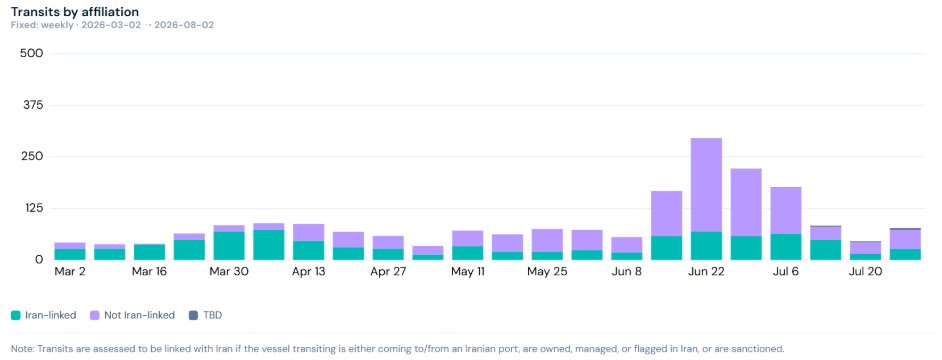
Source: Lloyd’s List Intelligence Strait of Hormuz Transit Monitor
Security summary
Iran takes aim at ships bypassing its traffic system. Since 1 August, two ships transiting via the Omani route have been struck, with at least one additional attempted attack. Although extensive dark activity makes it difficult to quantify total traffic via Oman’s coastline, the route remains in use with roughly a quarter of non-Iranian linked traffic confirmed using this channel.
US Central Command is maintaining its blockade of Iranian ports, reporting that 45 merchant ships have been redirected, two vessels disabled, and two boarded.
Progress has been made in talks between Oman and Iran over management of traffic through the Strait of Hormuz, according to US Secretary of State Marco Rubio, while President Trump has threatened further strikes should the chokepoint not be reopened.
Risk outlook
Owners and operators remain reluctant to send ships through Hormuz amid continued uncertainty. Mixed messaging from Tehran and Washington is doing little to restore confidence, while reports of diplomatic progress have yet to translate into any credible development that would alter risk calculations. Should that change, market participants will respond quickly.
Build-up of shadow fleet tankers off Pakistan and Oman. Tankers with a history of lifting Iranian crude are strategically repositioning near Duqm and Karachi, allowing them to move swiftly on any easing of the US blockade.
Join us on Thursday, August 6 for our next Strait of Hormuz Crisis webinar briefing. Register here.
* Lloyd’s List Intelligence defines a tanker as being part of the Shadow Fleet if it engages in one or more deceptive shipping practices indicating that it is involved in the facilitation of sanctioned oil cargoes from Iran, Russia or Venezuela. Or it is sanctioned for participation in sanctioned oil trades or is sanctioned for links to a company that is sanctioned for facilitating the export of sanctioned oil. Or it participates in a cargo delivery where at some point over the course of the delivery one party in the chain engages in one or more deceptive shipping practices.
Lloyd’s List defines an LPG carrier as being part of the LPG Shadow Fleet if it engages in one or more deceptive shipping practices, or if it is sanctioned by the US, UK or EU.
Seasearcher subscribers can activate the Shadow Fleet list by clicking the links above.
This briefing was compiled by the Maritime Intelligence Unit.
All analysis focuses on cargo-carrying vessels over 10,000 dwt.
.png)