Non-Iranian-linked Hormuz transits 5-11 October (most recent complete data):
- Total transits: 104 vs 126 (28 September – 4 October)
- Eastbound transits: 51 vs 68
- Westbound transits: 53 vs 58
- Tanker and gas carrier transits: 81 vs 105
Executive summary
Hormuz traffic remains relatively elevated despite an intensification of Iranian attacks. At least 104 non-Iranian-linked vessels, defined by ownership, trading exposure or sanctions status, transited Hormuz between 5 and 11 October. While that represents a 17% week-on-week decline, traffic was still 31% above the August weekly average. The preliminary data suggests operators maintaining active Middle East Gulf operations have not yet been deterred by the increased targeting of merchant shipping. At least 28 reported and confirmed attacks in October in the Strait of Hormuz and surrounding waterways so far.
Key takeaways
Lower traffic reflects slowing departures. At least 51 vessels exited the Middle East Gulf between 5 and 11 October, down from 68 the previous week. Inbound movements, a useful indicator of owner and operator confidence, dipped more modestly to 53 from 58. That included 38 crude tanker arrivals, despite crude tankers being Iran’s most frequently targeted vessel type. This was in line with September’s weekly average of 38 crude tanker arrivals.
Gulf states lobby Washington to release shadow fleet tonnage for shuttle trades. Middle East Gulf states are seeking approval for sanctioned tankers to be legitimately repurposed to support regional oil exports. Non-sanctioned shadow fleet vessels have already been ‘flipping’ into compliant trades since the conflict began. Around 45 tankers and gas carriers have moved into mainstream trades, helping fill capacity left by major owners and operators avoiding the region.
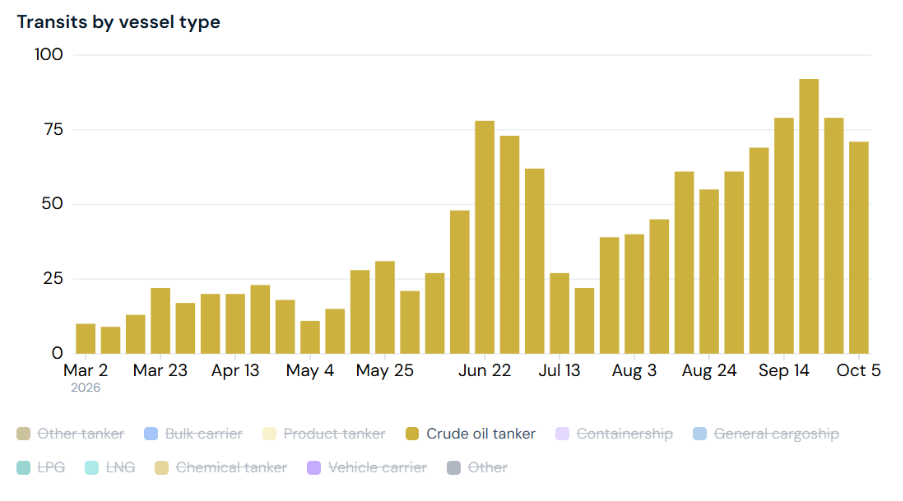
Source: Lloyd’s List Intelligence Strait of Hormuz Transit Monitor
Security summary
Iran expands its list of so-called non-compliant vessels to 124 ships. The Persian Gulf Strait Authority has added 43 vessels to its sanctions list. The list was first announced on 24 August with 44 vessels named, in a move widely viewed as an attempt to increase pressure on commercial shipping using the Strait of Hormuz.
October attacks have already reached their highest monthly total since the war began. At least 28 attacks or security incidents were recorded in the first half of October. The escalation has spread beyond tankers, with containerships, bulk carriers and gas carriers increasingly caught in attacks. Recent incidents have also extended beyond the strait itself and included vessels at anchor. Analysts say Tehran’s broader objective is to sustain uncertainty and demonstrate its ability to target ships across different ownership, cargo and trading profiles.
UK Maritime Trade Operations says attacks are being underreported. UKMTO, which provides verified maritime security information and alerts, says most vessels attacked are declining to report incidents, making it difficult to establish the true scale of activity across the Strait of Hormuz, Middle East Gulf and Gulf of Oman.
US Central Command continues to enforce its blockade of Iranian ports. Centcom says 138 merchant vessels have been redirected.
Risk outlook
Former Iranian, Russian and Venezuelan trading tonnage is increasingly being drawn into Middle East Gulf exports as operators look for vessels willing to accept the region’s heightened risk. But the shift of shadow fleet tonnage into compliant supply chains should not be mistaken for wholesale reintegration into the mainstream fleet. Many vessels retain opaque ownership structures, while others can be tracked switching between Iranian and non-Iranian trades on a voyage-by-voyage basis. That increases the burden on compliance teams. Due diligence must account for vessels moving between sanctioned and compliant trades against an evolving sanctions landscape, while the environmental and safety risks associated with shadow fleet tonnage remain unresolved.
Publication schedule
We are altering the publication schedule for the Strait of Hormuz Brief. It will now be published every other Thursday, with the next edition on 5 November.
If you missed the Week in Maritime Intelligence webinar, register to watch the briefing on demand. To register for every week in the series, complete this form.
* Lloyd’s List Intelligence defines a tanker as being part of the Shadow Fleet if it engages in one or more deceptive shipping practices indicating that it is involved in the facilitation of sanctioned oil cargoes from Iran, Russia or Venezuela. Or it is sanctioned for participation in sanctioned oil trades or is sanctioned for links to a company that is sanctioned for facilitating the export of sanctioned oil. Or it participates in a cargo delivery where at some point over the course of the delivery one party in the chain engages in one or more deceptive shipping practices.
Lloyd’s List defines an LPG carrier as being part of the LPG Shadow Fleet if it engages in one or more deceptive shipping practices, or if it is sanctioned by the US, UK or EU.
This briefing was compiled by the Maritime Intelligence Unit
All analysis focuses on cargo-carrying vessels over 10,000 dwt