Executive summary
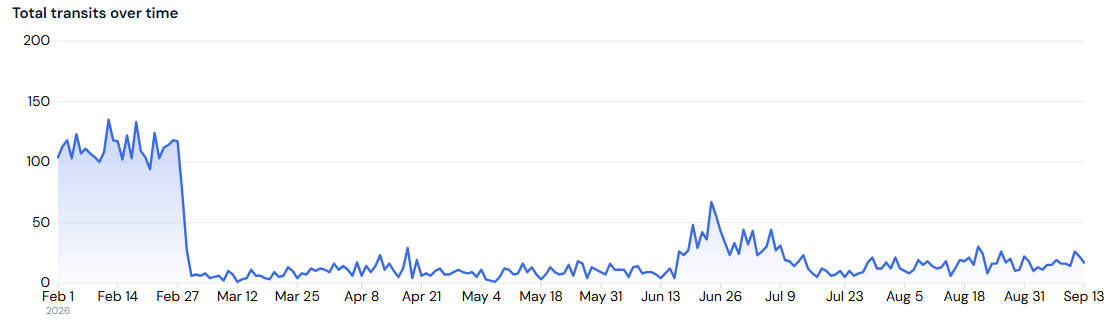
Traffic sustained at relatively elevated levels despite heightened Gulf violence. At least 97 non-Iranian-linked, defined by ownership, trade exposure or sanctions status, transits were tracked between 7 and 13 September, compared to 83 between 31 August and 6 September. These figures, particularly last week’s, are likely to rise further as additional dark transits are verified.
Non-Iranian inbound activity remains above post-conflict norms. In the lead up to the Memorandum of Understanding implementation in mid-June weekly westbound transits averaged 17. The MoU period led to a surge in inbound traffic, which quickly dropped after its collapse. In the four weeks after the MoU ended in mid-July an average of 23 ships transited Hormuz each week. This rose to 46 in the following four weeks (10 August to 06 September). Preliminary data for last week shows 47 westbound transits.
Crude tanker traffic holds steady while bulkers hit post-MoU high. At least 59 non-Iranian-linked crude oil tankers transited Hormuz between 31 August and 6 September. While the data for last week is incomplete due to a lag in dark transit assessments, 60 transits have already been captured. Meanwhile, at least 14 bulk carrier voyages have been recorded through Hormuz between 7 and 13 September, the most tracked since the MoU period.
Key takeaways
Crude market drives expansion in Gulf trade. Last week, and these numbers will be revised upwards as more dark transits are identified, 97 non-Iranian-linked transits were captured. The average for the two weeks prior was 84. While this is below the 101 recorded from 17 to 23 August, that week was a relative outlier with the weekly average in the three weeks prior being 67.
More non-Iranian-linked ships entering the MEG. Inbound movements provide a useful indicator of owner and operator confidence, and last week at least 47 westbound transits were recorded, with another 36 from 31 August to 6 September. Inbound crude oil tanker transits have been stable at a weekly average of 30 over 17 August to 6 September. Higher inbound transits indicate industry is adapting to the higher-risk operating environment, but activity is far below pre-conflict levels and there is no suggestion of a Hormuz revival.
Slight uptick in container trade in last ten days. Since September 7 non-Iranian-linked containerships have made five voyages through Hormuz. For context, five voyages were recorded over the three-week period prior. Nearly all the containerships tracked were sailing into the Gulf, and all are operated by a UAE-based entity that offers feedering operations in the Middle East.
Spot rates for all crude tankers are simultaneously surging. What began as a spike in the VLCC rates in the MEG has spread across crude tanker segments and trade routes as tightening vessel availability and shifting cargo movements drive up rates. Owners are benefiting while charterers deal with the eye-watering sums.
Charterers are seeking to lock in tanker tonnage on significantly longer time charter deals. Oil majors are increasingly seeking five, seven and even 10-year contracts to secure vessel availability. The push for longer-term charters is being driven by expectations that current trade patterns will endure and by concerns that an ageing fleet could limit future vessel availability.
Source: Lloyd’s List Intelligence Strait of Hormuz Transit Monitor
Security summary
Gulf states are integrating national security agencies into Hormuz shuttle tanker operations. MEG state security agencies are now engaged in across almost every aspect of shuttle tanker operations, from voyage planning and risk management to crewing and incident response. This is as producers increasingly treat the current shipping crisis as a long-term reality rather than a temporary disruption.
Iran has expanded its Strait of Hormuz sanctions list to 77 vessels and warned insurers, P&I clubs and classification societies against servicing these ships. It raises concerns that Tehran is seeking to increase pressure on ships defying its transit regime. A tanker on the list was struck over the weekend.
US Central Command continues to enforce its blockade of Iranian ports, reporting that 103 merchant vessels have been redirected.
Threat level to commercial shipping remains severe. According to the Joint Maritime Information Center deliberate hostile action is highly likely.
Risk outlook
Talks between Iran and Gulf states on future shipping arrangements in the Strait of Hormuz have been postponed, with no future date for talks stated. The Gulf states have not been unanimously aligned on any potential new shipping corridor. Iran is continuing to seek control over transits through the chokepoint.
Deteriorating security environment in the Middle East Gulf has not slowed shipping activity. Attacks over the last two weeks has highlighted the fact that the threat to shipping is not confined to strait but extends across the Middle East Gulf, Gulf of Oman and Iraqi territorial waters. Still, the preliminary figures for 7 to 13 September shows an increase in weekly volumes.
Shipping executives say recent geopolitical disruptions have reshaped energy trade flows and even a comprehensive peace settlement would not trigger an immediate return to pre-war trading patterns. Rebuilding depleted oil inventories, replenishing strategic reserves and diversifying crude sourcing beyond the Middle East are expected to continue to sustain tanker demand after the crisis ends.
Join us on Thursday, September 17 for our next Strait of Hormuz Crisis webinar briefing. Register here.
* Lloyd’s List Intelligence defines a tanker as being part of the Shadow Fleet if it engages in one or more deceptive shipping practices indicating that it is involved in the facilitation of sanctioned oil cargoes from Iran, Russia or Venezuela. Or it is sanctioned for participation in sanctioned oil trades or is sanctioned for links to a company that is sanctioned for facilitating the export of sanctioned oil. Or it participates in a cargo delivery where at some point over the course of the delivery one party in the chain engages in one or more deceptive shipping practices.
Lloyd’s List defines an LPG carrier as being part of the LPG Shadow Fleet if it engages in one or more deceptive shipping practices, or if it is sanctioned by the US, UK or EU.
Seasearcher subscribers can activate the Shadow Fleet list by clicking the links above.
This briefing was compiled by the Maritime Intelligence Unit.
All analysis focuses on cargo-carrying vessels over 10,000 dwt.
.png)