.png)
Executive Summary
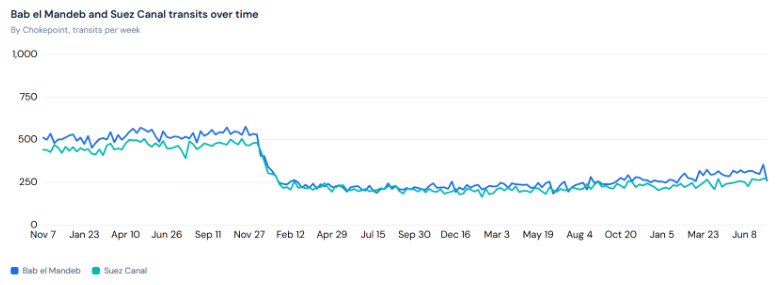
Vessel traffic through the Bab el Mandeb strait traffic fell 24% after the Houthis imposed a maritime blockade on Saudi Arabia, but transit volumes appear to have stabilised following the initial decline. The disruption is concentrated in the tanker sector but wider shipping traffic has been less affected.
Suez Canal traffic remains broadly unchanged, although an uptick in VLCC movements suggests tanker operators are rerouting and adjusting logistics.
Saudi crude exports are continuing through a combination of lighter loadings, partial discharge operations, and use of the Sumed pipeline to bypass Suez draught restrictions.
Security risks remain elevated with continued Houthi attacks and attempted strikes demonstrating both capability and intent to target commercial shipping linked to Saudi Arabia.
While industry behaviour has not yet shifted significantly, escalating attacks or broader targeting could rapidly trigger larger-scale vessel diversions, higher costs, and further pressure on Red Sea trade routes.
Key takeaways
Renewed tensions in the Red Sea have pushed traffic down to early 2026 levels. While transits fell to 269 during the week beginning 20 July, down from 354 in the week before the Houthis' maritime blockade of Saudi Arabia (July 13-19), traffic remains in line with the levels seen before the Strait of Hormuz disruption led to an influx of traffic to the Bab el Mandeb. Preliminary data for 27 July to 2 August show 266 transits, indicating traffic has remained relatively stable after the initial decline.
Disruption has been limited to the tanker market rather than impacting the wider shipping industry. Mainstream tanker traffic, those tankers that do not belong to the shadow fleet transporting sanctioned oil, dropped 42% in the week following the blockade to 53 transits. Tankers continue to call to Saudi Arabian ports, albeit more often with their vessel tracking systems disabled.
Suez Canal traffic is broadly unchanged, but tanker movements show rerouting is underway. A total of 275 transits were tracked through the Red Sea’s northern chokepoint between 27 July and 2 August, with almost no difference with the previous week at 273. Total tanker transit levels are within normal range, but VLCC traffic has quadrupled.
VLCCs are lightening loads to slip through the Suez Canal. Facing the Houthi blockade of Saudi Arabia’s Red Sea coast, VLCCs loading at Yanbu are reducing cargo volumes at point of load or partially discharging at Egypt’s Ain Sukhna to meet Suez Canal draught limits. After transiting Suez, the tankers are moving to Sidi Kerir to top up via the Sumed pipeline before continuing to their final destinations.
The Joint War Committee has expanded the Red Sea listed area for war risk insurance by around 800 km north, meaning calls to northern Saudi ports including Jeddah and Yanbu are subject to additional premiums.
Source: Lloyd’s List Intelligence Red Sea Transit Monitor
Security summary
Saudi Arabia’s proposed Red Sea security coalition, unveiled at the end of July, is being viewed as a diplomatic initiative rather than a meaningful enhancement to maritime security, with analysts questioning whether participating states can materially reduce Houthi threats. As a result, the coalition will not lead shipowners, charterers or insurers to change their Red Sea risk calculations.
The threat to shipping remains substantial, according to the Joint Maritime Information Center. The attack on a Saudi-flagged tanker reinforced both the Houthis’ capability and intent to target merchant vessels. Additional attacks are assessed as a strong possibility given intent and capabilities.
The Houthis have confirmed one successful strike on a tanker and have attempted several additional attacks against Saudi-linked vessels since announcing the maritime ban. On August 5 the master of a tanker reported hearing a loud explosion close to the ship while it was sailing in the Gulf of Aden, while a dhow was sunk on August 4 after being struck by a projectile off Yemen. The Houthis have not claimed responsibility for the latter attack.
Risk outlook
The Houthis have denied reports that they plan to charge vessels for transiting the Bab el Mandeb Strait, maintaining that safe-transit assurances remain voluntary and free of charge.
VLCC rerouting via Suez enables Saudi Red Sea crude exports to continue reaching Asian buyers, but the detours lengthen voyage times and add additional costs.
The latest Red Sea escalation has yet to prompt a broad shift in industry behavior. However, operators' willingness to transit could quickly weaken and diversions in greater numbers would materialise if the Houthis widen their targeting criteria or step up attacks.
If you missed our latest Strait of Hormuz Crisis webinar, which included updates on developments in the Red Sea, register to watch the briefing on demand here
This briefing was compiled by the Maritime Intelligence Unit
All analysis focuses on cargo-carrying vessels over 10,000 dwt.
.png)