Executive Summary
The Houthis are beginning to enforce their maritime ban on Saudi Arabia, claiming responsibility for two attacks (with one confirmed). However, the impact on Saudi-linked shipping remains uneven. While there is evidence of rerouting and increased dark activity, vessels continue to sail from Saudi ports through the Bab el Mandeb.
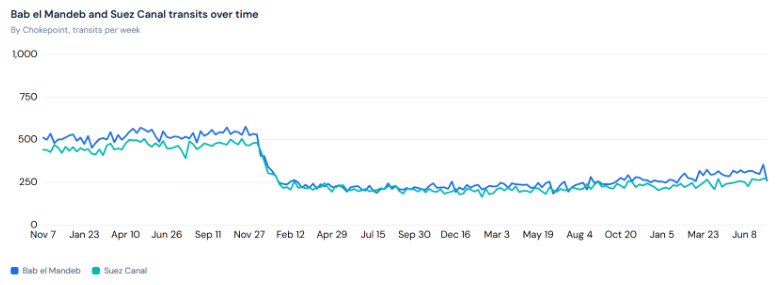
Traceable Bab el Mandeb transits fell 28% week on week as some vessels diverted and others switched off AIS. The rise in dark activity is depressing visible traffic figures, making it too early to assess the blockade's full impact.
There is no evidence yet of a mass withdrawal from the Red Sea. Tankers appear most exposed to disruption, but containership traffic, which has grown steadily in recent months, has yet to see a material decline.
Key takeaways
Dark activity and rerouting are increasing following the Houthi ban on Saudi ports. AIS-visible transits totaled 225 during July 20-26, down from 311 the previous week. While within the normal range, this is below June's weekly average of 273 traceable movements.
Preliminary data shows 263 total transits during July 20-26, down from 354 a week earlier. The current count includes 38 dark transits, although this is almost certainly understated and will be revised higher as additional data becomes available.
Disruption is concentrated in crude exports. Only one crude tanker has been tracked calling at a Saudi Red Sea port since July 23, suggesting owners are either abandoning voyages or conducting operations in the dark. On July 27, 11 ballast crude tankers ceased AIS transmissions off or approaching Yanbu, Saudi Arabia's key alternative export outlet to Hormuz-constrained Gulf shipments. Meanwhile, China's largest state-owned tanker operators are withdrawing VLCCs from Red Sea trade.
Traceable calls at Saudi Red Sea ports have slowed to a trickle. No arrivals were recorded with AIS active on July 28, compared with an average of 13 daily port calls before the Houthi ban. Despite this, vessels departing Saudi ports continue to transit the Bab el Mandeb.
The containership sector remains resilient. Boxship movements showed little change last week, and major carriers, including Maersk, continue to operate trans-Suez services. Eighteen container lines sent vessels through the Bab el Mandeb between July 21 and 27.
Source: Lloyd’s List Intelligence Red Sea Transit Monitor
Security summary
The Houthis have confirmed one successful strike on a tanker and have attempted several additional attacks against Saudi-linked vessels since announcing the maritime ban.
Houthi messaging indicates Saudi-linked interests remain the primary target, and they have stated that there is no complete closure of the Bab el Mandeb.
Risk outlook
The latest Red Sea escalation has not prompted an industry-wide retreat. However, market sentiment could shift quickly if the Houthis broaden their targeting criteria or increase the frequency of attacks.
Recent developments echo the early stages of the 2023-24 Red Sea crisis. The seizure of the Galaxy Leader in November 2023 did not trigger widespread rerouting around the Cape of Good Hope. Large-scale diversions only followed when attacks appeared to become increasingly indiscriminate and operators concluded that all shipping faced elevated risk.
The Bab el Mandeb has never been fully closed to commercial shipping. Even at the height of the Red Sea crisis, traffic volumes fell by about 60% rather than ceasing altogether.
If you missed our latest Strait of Hormuz Crisis webinar, which included updates on developments in the Red Sea, register to watch the briefing on demand here.
This briefing was compiled by the Maritime Intelligence Unit
All analysis focuses on cargo-carrying vessels over 10,000 dwt.