Executive Summary
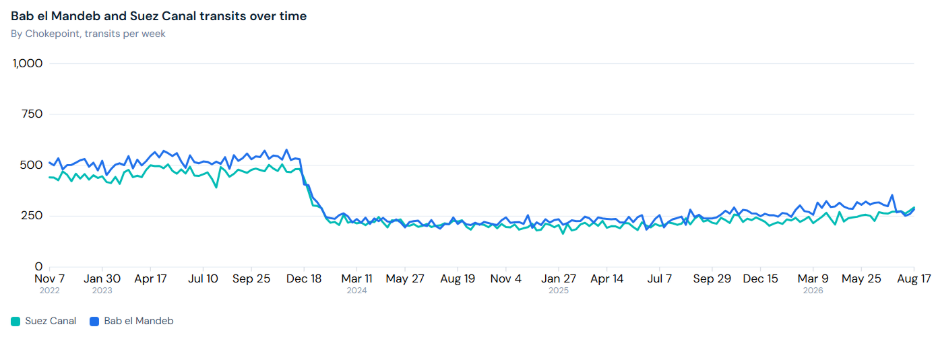
Suez traffic keeps trending upwards. Transits through the canal for the four weeks ending August 23 (27 July – 23 August) were at their highest levels since the equivalent four-week period ending 4 February 2024, shortly after the Houthi campaign began. However, this was still 40% lower than an equivalent pre-Houthi attack period.
Bulkers and boxships up, tankers down, and gas carriers flat. Tanker transits through Suez for the week of August 17-23 fell 3.8% week-over-week, bulk carrier and containership transits increased 22.2% and 15.4%, respectively, and gas carrier transits remained flat.
Bab el Mandeb traffic rises. Preliminary figures show weekly Bab el Mandeb volumes rose week-over-week. Tankers (13.6%), containerships (10%) and bulk carriers (12.2%) all increasing by double digits, with figures likely to be revised upwards as more dark transits are identified.
Saudi-linked tonnage remains the primary target of Houthi attacks. The Bahri-owned VLCC Amzan was struck by a projectile off Yanbu on 24 August, causing a fire but no casualties or environmental impact. The attack fits the pattern established since the Houthis declared a naval blockade on Saudi Arabia on 20 July, with several Bahri-controlled vessels targeted in the weeks since.
Key takeaways
Suez Canal volumes continue their recovery. While traffic is still well below pre-war levels, volumes continue to climb up and reach post-war highs. Total traffic through the Suez Canal increased 5.8% week-over-week, while preliminary Bab el Mandeb figures show an increase of 9.2%.
Container lines continue their gradual return to the Red Sea. Mediterranean Shipping Company stated that it will resume a limited number of east-west sailings through the Suez Canal following a “comprehensive review” of security and operational conditions. MSC’s announcement comes after at least seven of its vessels transited through the Bab el Mandeb over the past three weeks, according to Lloyd’s List Intelligence data. Maersk and Hapag-Lloyd Gemini cooperation has been steadily routing more services back through Suez since February.
Crude tanker owners are benefiting from disruption. The Hormuz shuttle-STS trade and the Red Sea shuttle-pipeline route via Yanbu, Sumed and Sidi Kerir are both adding tonne-miles and tying up tonnage through waiting, repositioning and transfer delays.
Saudi Arabia is pursuing a state-backed war risk insurance mechanism. Saudi Export-Import Bank held talks in preliminary talks with Lloyd’s re/insurer MS Amlin, which proved inconclusive. However, Saudi authorities are still keen to develop the proposal.
Security summary
Bahri-owned VLCC hit by projectile off Yanbu. UKMTO reported the attack on the Saudi-flagged Amzan around 0637 hrs, roughly 63 nautical miles west of Yanbu, causing a fire on the main deck. All crew were reported safe. The Houthis have not claimed responsibility, but the target and location match the group’s recent pattern of activity against Saudi-linked shipping.
Threat levels remain elevated. The Joint Maritime Information Center continues to assess the risk to commercial shipping as substantial.
Risk outlook
Sixth hijacking since April underscores a piracy resurgence in the Gulf of Aden. With Somali pirate groups re-establishing a presence in the Gulf of Aden, the IMO’s call for renewed international naval cooperation points to a security challenge that will likely persist independently of any resolution to the Red Sea situation.
Carrier return decisions remain provisional and reversible. MSC’s cautious, limited-scope return indicate that container lines are treating the security situation as fluid.
If you missed our latest Strait of Hormuz Crisis webinar, which included updates on developments in the Red Sea, register to watch the briefing on demand here.
This briefing was compiled by the Maritime Intelligence Unit
All analysis focuses on cargo-carrying vessels over 10,000 dwt.
.png)