Executive Summary
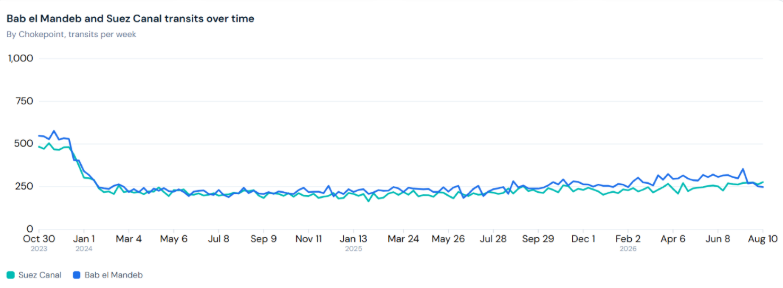
Suez Canal traffic reaches highest level in more than two years. Nearly 1,090 transits, equivalent to 88.6m dwt, passed through the Red Sea's northern chokepoint over the past four weeks, up from 1,070 in the four weeks prior (22 June to 19 July). This is the highest volume recorded since January 2024 (8 January to 4 February). While a welcome development for Egypt and a key source of revenue, traffic remains 41% below pre-crisis levels.
Containerships and LNG carriers drive the recovery. Crude tankers are boosting tonnage as VLCCs carrying Yanbu crude opt for the Suez Canal to avoid the Bab el Mandeb. However, higher traffic reflects a broader shift driven by multiple vessel segments.
Bab el Mandeb traffic shows signs of stabilisation. There were 223 AIS-enabled transits between 10 and 16 August, broadly in line with levels recorded after the Saudi naval blockade was imposed. Dark transits are still being identified, but at least 252 vessels passed through the strait last week, unchanged from the previous week. Weekly fluctuations remain significant, making it too early to determine whether traffic has fallen further following the initial decline after the maritime ban.
Key takeaways
Suez Canal traffic continues to recover. Between 20 July and 16 August, 1,088 transits were recorded through the canal, compared with 1,070 between 22 June and 19 July. The average four-week transit volume between January and mid-June was 946, indicating a 14% increase, supported in recent weeks by rising containership and LNG carrier movements.
Major carriers are progressively restoring Asia-Europe services via Suez. Containerships that had avoided the route since late 2023 and early 2024 have resumed Red Sea transits. MSC has increased sailings, with seven vessels crossing the Bab el Mandeb in the past two weeks. Maersk says more than 30% of Asia-Europe volumes previously routed around the Cape of Good Hope have returned to Suez and argues conditions for a full return have largely been met, despite ongoing port and landside constraints.
Mainstream crude tanker transits through Bab el Mandeb remain subdued. Some owners and operators continue to avoid Saudi Red Sea port calls. However, oil exports from ports such as Yanbu continue, with some tankers disabling AIS during loading and then exiting via the Suez Canal.
Bab el Mandeb traffic remains below pre-blockade levels. At least 252 transits were recorded last week, unchanged from the previous week. The figure is expected to rise as additional dark transits are identified. Average weekly traffic in the six months before the blockade was 296 transits, compared with 265 in the three weeks following the 20 July restrictions.
P&I market moves quickly to maintain Red Sea cover. International Group clubs have introduced buyback cover after reinsurers withdrew support for ancillary war-risk products, helping to avoid the premium spikes seen during previous crises. Saudi-owned, operated and flagged vessels appear subject to blanket exclusions under charterers' buyback arrangements. Cover remains available for non-Saudi-linked tonnage, while Red Sea transit pricing is being assessed on a case-by-case basis rather than through broad market increases.
Source: Lloyd’s List Intelligence Red Sea Transit Monitor
Security summary
Cargo vessel declared constructive total loss after attack off Al Mukha. The vessel was struck by multiple unidentified projectiles while unmanned, with no casualties reported. The attack follows a series of missile incidents in waters off Al Mukha.
Shipping threat levels remain elevated. According to the Joint Maritime Information Center, the risk to commercial shipping remains substantial. Houthi messaging continues to indicate that Saudi-linked vessels face the greatest risk of targeting.
Risk outlook
Red Sea tensions continue to support tanker earnings. Although regional tensions have disrupted tanker trading patterns, they have not triggered complete rerouting via the Cape of Good Hope. Crude tanker owners are benefiting from the strongest market conditions in two decades as disruptions in the Red Sea and elsewhere support elevated spot rates.
Piracy resurgence highlights evolving regional threats. A sanctioned product tanker was hijacked in the Gulf of Aden on 20 August and diverted towards Somalia, marking the second piracy-related vessel seizure in four days. The incidents reinforce concerns that Somali pirate groups are re-establishing their presence along one of the world's busiest shipping routes.
If you missed our latest Strait of Hormuz Crisis webinar, which included updates on developments in the Red Sea, register to watch the briefing on demand here.
This briefing was compiled by the Maritime Intelligence Unit
All analysis focuses on cargo-carrying vessels over 10,000 dwt.