A vetting request lands with a cargo type, a voyage, and a clock already running. You need an answer in 30-60 minutes: is this vessel suitable to carry this cargo to this port, or should it be rejected, escalated, or approved with conditions? That timeframe is set by the business, not by how quickly the risk data comes together.
Yet the signals a vetter actually needs - inspection history, class status, machinery condition, incident and casualty records, dry dock status, route and terminal risk - rarely sit in one place. They're spread across systems that weren't built for a nomination-to-approval decision, so vetters end up checking vessels one by one, interpreting inconsistent reports, and inferring operational risk that should already be visible.
The result is a process that's slower than the commercial pressure allows, and harder to stand behind than it should be if a decision is questioned later.
Where the friction actually sits
It isn't a shortage of information - it's how much manual synthesis and interpretation stands between the data and the decision.
- Subjective inspection and class reports - dense, inconsistently formatted, and reliant on individual judgement to translate into a clear risk view.
- Manual inference of operational risk - condition and readiness often have to be pieced together rather than read directly off a single source.
- Low trust in abstract risk scores - a flag without context doesn't tell a vetter whether a vessel is genuinely unsuitable or just imperfectly documented.
- Fragmented route and terminal risk - cargo-vessel compatibility, port safety, and voyage risk are assessed separately rather than alongside vessel condition.
- Weak documentation - when a decision is challenged after the fact, the justification has to be reconstructed rather than simply retrieved.
Under time pressure, each of these adds friction. Together, they push vetters toward either slower decisions or less confident ones - neither of which is acceptable when a fixture is on the line.
What faster, safer approval looks like
The fix is the same principle underwriters need: one trusted, consolidated view built around how a nomination decision actually gets made - not another data source to check separately.
Dry dock visibility is the clearest differentiator here. Knowing whether a vessel has recently left dry dock - and what was found - is one of the most material indicators of operational readiness, yet it's typically the hardest signal to find quickly today. Alongside it, a centralised operational screening panel brings inspections, incidents, machinery condition, and detentions into a single view, and multi-vessel port call filtering removes the need to check port history vessel by vessel.
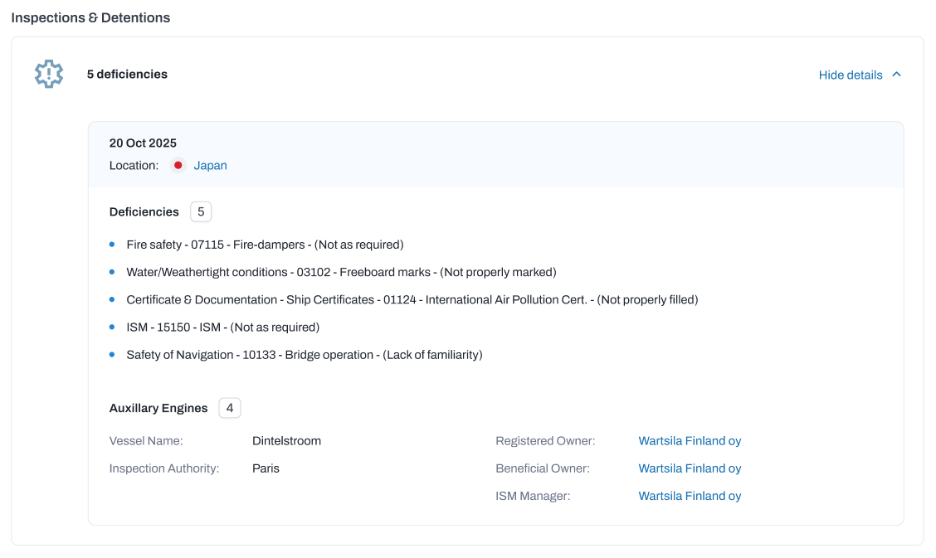
This is what Vessel Due Diligence is built to do: bring operational readiness, incident history, and route risk together in one workbench, so vetters can approve, reject, or condition a nomination faster - with a decision they can document and defend.
The cost of standing still
Fragmented data doesn't just slow vetters down. It creates inconsistency between decisions made by different vetters under the same time pressure, weakens the audit trail organisations need when a decision is questioned or a claim arises, and puts commercial fixtures at risk of delay for reasons that have nothing to do with the vessel itself.
Approving a nomination will always require judgement. It shouldn't also require assembling the evidence from scratch every time.
Ready to see it for yourself? Request a demo of Vessel Due Diligence today!
.png)