Executive summary
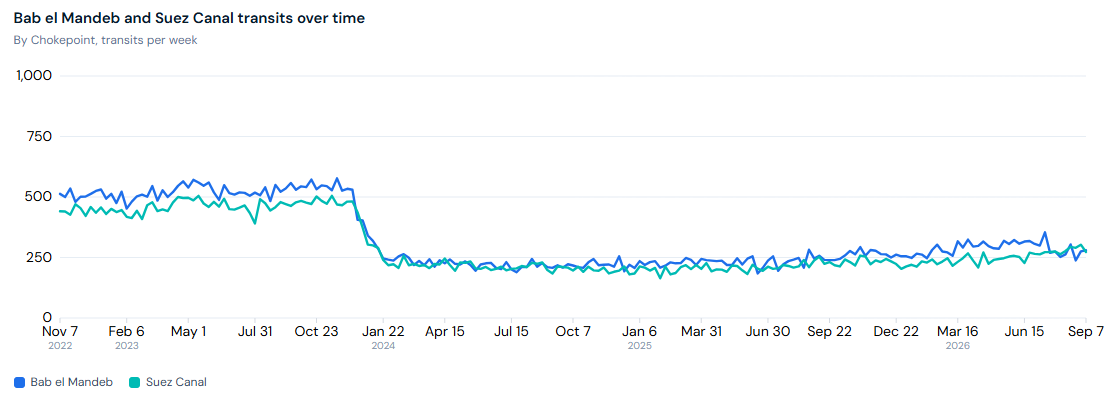
Suez Canal recovery gathers pace but Bab el Mandeb revival stalls. Suez transits totalled 1,232 in August, up 28% year on year (YoY), while 1,165 voyages were made through the BEM, up 6% YoY but down 49% month on month.
Mega-boxships are returning to the Red Sea, a clear indicator that carriers are growing increasingly confident in using the route.
Key takeaways
Suez Canal transits have exceeded 1,200 for two consecutive months. Recovery of traffic through the Egyptian waterway accelerated in July, and in August transit volumes were up 28%, while tonnage rose 43% month on month. August was also the busiest that the Suez Canal has been since December 2023. The return to the Red Sea’s northern chokepoint had been slowly building during the past year but had been helped by the disruption in the Strait of Hormuz and changes to Saudi oil export routes. However, it is too early to assess the extent of the impact of the recent attacks on Saudi Arabia’s East-West Pipeline on Suez activity.
This year 44 ultra-large containerships transited the Bab el Mandeb, including 39 crossings since July. Just one boxship of this size transited the Red Sea’s southern chokepoint during 2025. Total containership traffic by capacity, has more than doubled YoY suggesting liner operators are continuing to reintegrate the corridor into their east-west networks. Activity remains 70% lower than pre-Houthi crisis levels, but the renewed Houthi threats in the Bab el Mandeb has yet to derail the increasingly rapid return to the Red Sea.
Renewed Houthi threats against Saudi shipping have effectively erased much of the Bab el Mandeb’s traffic growth generated by the Strait of Hormuz crisis. In August, 1,166 transits were made through the Red Sea’s southern chokepoint, equivalent to 92.7m dwt. This is a drop of 14% and 19% respectively, month on month.
Traceable Saudi-affiliated transits (through flag or ownership) through the Bab el Mandeb collapsed after the Houthis’ July embargo declaration. Only one Saudi-linked tanker has completed a transit since July 20. While there is a faction of industry avoiding the region, there remains to a degree a revival in Bab el Mandeb transits. Several high-profile, US-listed shipping companies are continuing to send vessels through, including ships that haven’t sailed via the waterway in over two years. EU-owned tonnage, excluding Greece, is also making gains with traffic more than doubling in the space of a year, and increasing 13% from July to August.
Source: Lloyd’s List Intelligence Red Sea Transit Monitor
Security summary
The Houthis’ seizure of Mokha and reported advances towards Perim and the Hanish islands has expanded their presence around the Bab el Mandeb, with security analysts warning the new positions could enhance their ability to monitor shipping, observe vessel movements and strike designated targets. The Houthis have sought to reassure the shipping industry that Red Sea navigation remains safe, except for vessels covered by its declared embargo on Saudi shipping.
Recent successful hijackings have renewed concerns over Somali piracy, with maritime authorities issuing fresh warning regarding the increasingly active piracy threat across the Gulf of Aden and waters off Somalia.
The September 10 attack on Saudi Arabia’s East-West Pipeline has halted crude exports from the Red Sea port of Yanbu. It is uncertain when the pipeline will return to service. Prior to the attack, and since the Houthis implemented a naval ban on Saudi Arabia, Bahri had repositioned part of its fleet to support exports from the Middle East Gulf.
Risk outlook
Red Sea is still far away from a full recovery, but it is undeniably under way. In August there were 1,232 transits (102.4m dwt) through the Suez Canal, down 39% on pre-Houthi crisis levels. However, this figure is substantially above the figures seen during the depths of disruption when the average monthly traffic was 884 transits (66m dwt). Activity through the Bab el Mandeb in August hit 1,166 transits (92.7m dwt), down 49% on 2023 figures. During the Red Sea’s worst period monthly transits averaged 965 (65.9m dwt).
The renewed tensions in the Red Sea have had a limited impact on the wider shipping industry, with the market adjusting accordingly. As such, the Red Sea Brief will now be published every other week unless there is a change in circumstances.
If you missed The Week in Maritime Intelligence webinar, register to watch the briefing on demand here
This brief was compiled by the Maritime Intelligence Unit
All analysis focuses on cargo-carrying vessels over 10,000 dwt