Executive Summary
Bab el Mandeb traffic stable for first two weeks of Saudi blockade. At least 273 passings were recorded through the Red Sea’s southern chokepoint from 27 July to 2 August, up marginally from 269 the week prior. Averaging these two weeks against the month prior to the ban shows traffic has slowed about 15%.
Traceable transits tumbled last week. There were 200 transits through the Bab el Mandeb between 3 to 9 August where AIS was enabled. This is down from 226 the week prior and is the lowest weekly number of traceable transits in a year. While it is an unusually low figure, more data is needed to understand if there is genuinely less traffic, if more ships have opted to transit dark, and if this is an outlier in the dataset.
No change to mainstream crude transits in second week of Saudi naval blockade with traffic through the Bab el Mandeb remaining 38% below normal volumes.
Major container lines that abandoned the Red Sea at the end of 2023 and early 2024 — and stayed away for about two years — have pressed ahead with their return to the region despite the renewed hostilities.
Modest decrease in Suez Canal traffic as disruption concentrated on southern chokepoint. High-level figures show Suez traffic to be stable with 263 transits between 3 August and 9 August, down from 275 the week prior.
Key takeaways
Traceable transits through the Bab el Mandeb fell as bulker, containership and crude tanker passings declined. While traffic volumes across all three segments remain within normal levels, bulk carrier transits are the most prone to swings — a reflection of how directly the segment responds to the market.
Non-shadow fleet tanker transits down about 40%. There were 53 mainstream tanker transits from 20 to 26 July and 54 from 27 July to 2 August. This is down from 91 between 13 and 19 July, and 82 the week prior.
Increase in mainstream tankers operating “dark” as owners and operators adjust to new risk. From April to June there were on average 70 tankers each month navigating the Red Sea with their AIS disabled. This increased to 86 in July as ships took extra precautions to hide activity, particularly those loading at Saudi ports.
Maersk is gradually restoring Asia-Europe services via the Suez Canal. Having rerouted ships around the Cape of Good Hope at the onset of the Red Sea crisis in late 2023, major carriers including Maersk and MSC are steadily expanding trans-Suez operations, while keeping an eye on the volatile situation in the Bab el Mandeb.
Efforts to offset lost Middle East crude supply are losing steam. Falling exports from the US Gulf, Black Sea and Yanbu have deepened the global oil deficit, yet tanker rates remain exceptionally strong as longer voyages and geopolitical disruption continue to constrain effective fleet supply.
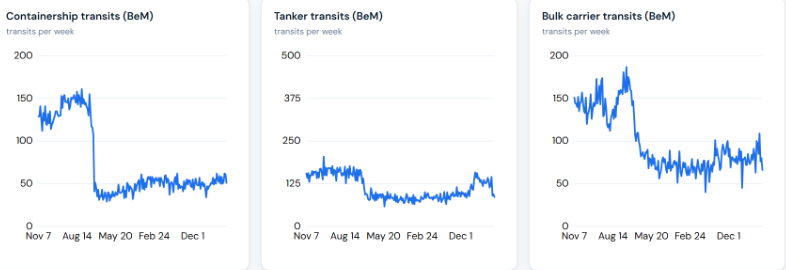
Source: Lloyd’s List Intelligence Red Sea Transit Monitor
Security summary
Casualties recorded after vessel hit in the Red Sea. The Houthis have not claimed responsibility for the attack that has left six people dead, but multiple open sources attribute the strike to the Houthis.
The threat to shipping remains substantial, according to the Joint Maritime Information Center. The Houthi messaging continues to indicate that Saudi-affiliated vessels are most at risk of being targeted.
Risk outlook
Houthis’ ban on Saudi-affiliated traffic has not triggered widespread diversions. Risk calculus can change quickly, and rerouting decisions would be made should the situation escalate or the Houthis widen their targeting criteria.
If you missed our latest Strait of Hormuz Crisis webinar, which included updates on developments in the Red Sea, register to watch the briefing on demand here
This briefing was compiled by the Maritime Intelligence Unit
All analysis focuses on cargo-carrying vessels over 10,000 dwt.
.png)