.png)
Executive summary
Tehran’s targeting of Hormuz users and Washington’s blockade of Iranian ports continue to suppress traffic volumes, although a small core group of operators remains active. Preliminary data show 73 transits between 10 and 16 August, down from 91 the previous week.
Non-Iranian traffic continues to flow in both directions, with at least 22 vessels entering the Gulf and 21 departing from 10 to 16 August. Crude tankers accounted for most movements. These figures are expected to rise as additional dark transits are identified.
Conflicting statements from Washington and Tehran highlight the widening diplomatic divide, making a near-term breakthrough increasingly unlikely.
High-risk operators are exploiting a shortage of owners willing to transit Hormuz. At least four very large gas carriers with a history of carrying Iranian LPG have loaded cargoes in the UAE and Qatar in recent weeks.
A bifurcated tanker market is emerging west of Hormuz. Access to transportation capacity has become a strategic asset, prompting national oil companies to secure greater control over tonnage and pay a premium for that flexibility.
Key takeaways
Non-Iranian-linked traffic, defined by ownership, trade exposure or sanctions status, has remained relatively resilient following the collapse of the Memorandum of Understanding. Preliminary figures show 68 transits between 27 July and 2 August and 60 between 3 and 9 August, up from 34 and 35 in the two weeks immediately after the MoU ended. Preliminary data for 10-16 August show 43 non-Iranian-linked transits, with further revisions likely as additional voyages are identified. This compares with a weekly average of 37 transits between April and the start of the MoU.
DP World is spending around $100m per month to keep Jebel Ali ready for reopening, as container throughput remains at roughly 10% of normal levels. Cargo is being rerouted through Fujairah, Khor Fakkan, Oman and the Jeddah land bridge, while DP World accelerates development of Fujairah facilities designed to bypass the strait.
High-risk shadow fleet operators are capitalising on the shortage of willing shipowners. At least four very large gas carriers with a history of transporting Iranian LPG, though not themselves sanctioned, have loaded cargoes in the Middle East Gulf in recent weeks. Before the conflict, it was rare for vessels linked to sanctioned trades to re-enter mainstream markets.
Spot tanker rates continue to surge across both VLCC and suezmax markets. The strongest gains are on trades exposed to Hormuz and disrupted crude flows. TD3C Middle East Gulf-China earnings are now above $520,000 per day, while Oman-China rates have also strengthened as ship-to-ship transfer activity off Oman and Fujairah increases. The rally comes despite declining global oil exports, reflecting strong import demand, record refinery margins and diminishing expectations of anear-term resolution to the crisis.
Abu Dhabi National Oil Co provides the clearest example of how national oil companies are prioritising control of tonnage. Rather than relying on third-party owners to transit Hormuz, Adnoc is increasingly securing its own shipping capacity. The company is among those moving cargoes from Gulf terminals to ship-to-ship transfer locations beyond the strait, where they can be loaded onto long-haul vessels bound for Asia. Adnoc Logistics & Services recently disclosed acquisitions of six VLCCs and five VLGCs worth a combined $1.3bn. Several recent secondhand VLCC purchases have also been concluded at prices well above conventional asset valuations.
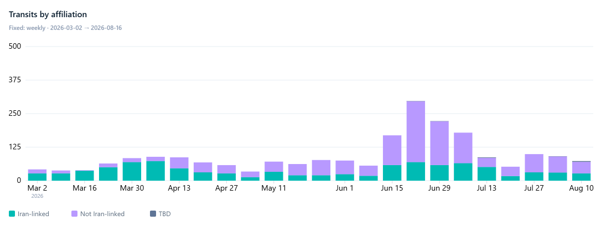
Source: Lloyd’s List Intelligence Strait of Hormuz Transit Monitor
Security summary
Maritime security conditions continue to deteriorate. One seafarer was killed after a bulker was struck this week. No group has claimed responsibility. Iran's semi-official Fars news agency also reported the seizure of an Emirati-affiliated tanker near Qeshm Island, although the report remains unconfirmed.
US Central Command continues to enforce its blockade of Iranian ports, reporting that 64 merchant vessels have been redirected, three disabled and two boarded.
Risk outlook
The ‘flipping’ of shadow fleet LPG carriers into mainstream trades mirrors an established trend in tanker markets. Since the conflict began, 30 non-sanctioned shadow fleet tankers and gas carriers have lifted compliant cargoes, including five VLCCs. While not all vessels entering mainstream trade shave previously carried Iranian cargoes, those that have face heightened sanctions exposure and could attract scrutiny from the US Office of Foreign Assets Control.
Tanker markets are increasingly pricing in a prolonged Hormuz disruption. An extended crisis would sustain elevated risk premiums, deepen crude supply disruptions and delay inventory rebuilding. It could also reinforce the divide between owners willing to assume Hormuz exposure and those withdrawing tonnage, supporting both freight rates and vessel values.
US-Iran diplomacy has effectively collapsed, removing any credible near-term pathway to de-escalation. Yet shipping activity has not ceased. Operators continue to move cargoes, adapting to a significantly higher-risk trading environment.
Join us on Thursday, August 20 for our next Strait of Hormuz Crisis webinar briefing. Register here.
* Lloyd’s List Intelligence defines a tanker as being part of the Shadow Fleet if it engages in one or more deceptive shipping practices indicating that it is involved in the facilitation of sanctioned oil cargoes from Iran, Russia or Venezuela. Or it is sanctioned for participation in sanctioned oil trades or is sanctioned for links to a company that is sanctioned for facilitating the export of sanctioned oil. Or it participates in a cargo delivery where at some point over the course of the delivery one party in the chain engages in one or more deceptive shipping practices.
Lloyd’s List defines an LPG carrier as being part of the LPGShadow Fleet if it engages in one or more deceptive shipping practices, or if it is sanctioned by the US, UK or EU.
Seasearcher subscribers can activate the Shadow Fleet list by clicking the links above.
This briefing was compiled by the Maritime Intelligence Unit.
All analysis focuses on cargo-carrying vessels over 10,000 dwt.