Executive summary
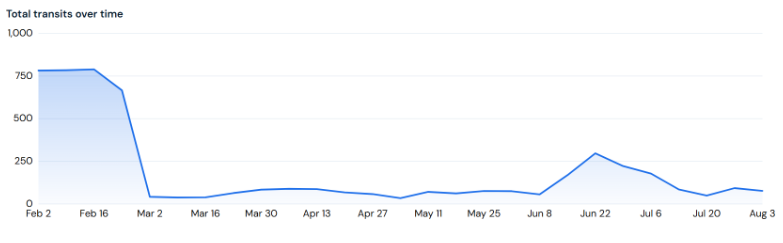
Traffic continues to flow through Strait of Hormuz despite increased kinetic military activity. Preliminary data show 78 transits during 3 to 9 August, down from 95 the previous week. Non-Iranian-linked traffic is above levels seen just after the collapse of the MoU, but a far cry from normal volumes.
Expectations of an imminent return to the Gulf dashed by Tehran. Iran’s top security official has insisted that the reopening of the chokepoint is conditional on the US accepting its extensive terms.
Non-Iranian inbound transits remain at modestly elevated levels for the second consecutive week. Movements into the Gulf initially plummeted after the collapse of the MoU, and while westbound traffic remains depressed, it is above the pre-MoU average.
Marine insurers estimate the Middle East Gulf conflict has generated $1.5bn-$2bn in claims from around 70 casualties since the end of February.
Key takeaways
Dip in non-Iranian-linked — defined by ownership, trade exposure or sanctions status — traffic week-on-week, although volumes remain above post-MoU collapse levels. Preliminary figures show 45 transits during 3 to 9 August, down from 63 the previous week. There were 33 transits recorded between 13 to 19 July, the week after the reignition of tensions in the Gulf.
Spot rates for LNG carriers have softened as excess tonnage and weaker demand have outweighed ongoing concerns over the Strait of Hormuz. LNG market is increasingly being driven by supply-demand fundamentals, rather than geopolitics.
Non-Iranian ships entering the Gulf are above the pre-MoU period average for the second week in a row. At least 23 westbound transits were recorded last week, with another 28 tracked the week prior. Before the MoU, which led to a relative surge in inbound traffic, the weekly average was 15.
An estimated 1.8m-2m teu of global container volumes was lost to disruption in the Middle East Gulf during the first half of 2026, with regional imports down 21% and exports down 31%, according to Container Trades Statistics. Global container trade continued to expand in H1 despite the situation in the Middle East, highlighting the resilience of demand outside the traditional east-west trade lanes.
Major crude “shuttlers” undeterred by attacks on their tankers. Sinokor, Abu Dhabi National Oil Co and Kuwait-owned ships have continued exporting oil from the Gulf, notable given that tankers associated with these companies were struck about a month earlier.
Source: Lloyd’s List Intelligence Strait of Hormuz Transit Monitor
Security summary
Iran continues to attack, and attempt to attack, vessels transiting Hormuz. Activity has been focused on the Omani coast, where ships avoiding Iran’s traffic system are transiting. Merchant shipping continues to navigate via this route despite the risk.
US Central Command is maintaining its blockade of Iranian ports, reporting that 55 merchant ships have been redirected, three vessels disabled, and two boarded.
Tehran has laid out the conditions for a Hormuz reopening, with Iran’s top security official, Mohsen Rezaei, saying the strait would remain closed unless the US releases Iran’s frozen assets and puts an end to conflicts throughout the region, including in Lebanon. Traffic through Hormuz will continue at significantly reduced volumes as long as the tensions between the US and Iran persist.
Risk outlook
Underwriters concerned that continuation of Hormuz crisis for another six months would see hundreds of vessels filing total loss claims after 12 months’ deprivation of use. Earlier estimates suggested that if that eventually materialised, payouts at Lloyd’s alone could hit $20bn on ships, although fears of payouts on that scale have receded somewhat given a significant number of vessels were able to leave during the MoU period.
Repeated disruptions, including the Gulf and beyond, are driving commodity buyers away from highly optimised supply chains and towards more resilient, disruption-proofed supply chains that guarantee the cargo gets where it needs to go. Current inefficiencies – longer voyages, port congestion and rerouting – is what is keeping freight markets elevated.
Join us on Thursday, August 13 for our next Strait of Hormuz Crisis webinar briefing. Register here.
* Lloyd’s List Intelligence defines a tanker as being part of the Shadow Fleet if it engages in one or more deceptive shipping practices indicating that it is involved in the facilitation of sanctioned oil cargoes from Iran, Russia or Venezuela. Or it is sanctioned for participation in sanctioned oil trades or is sanctioned for links to a company that is sanctioned for facilitating the export of sanctioned oil. Or it participates in a cargo delivery where at some point over the course of the delivery one party in the chain engages in one or more deceptive shipping practices.
Lloyd’s List defines an LPG carrier as being part of the LPG Shadow Fleet if it engages in one or more deceptive shipping practices, or if it is sanctioned by the US, UK or EU.
Seasearcher subscribers can activate the Shadow Fleet list by clicking the links above.
This briefing was compiled by the Maritime Intelligence Unit.
All analysis focuses on cargo-carrying vessels over 10,000 dwt.
.png)