Executive Summary
Suez Canal traffic remains elevated for second consecutive week. Weekly transits through Egypt’s key chokepoint are at levels not seen since the start of 2024, when the mass exodus of vessels from the Red Sea was underway.
Bab el Mandeb disruptions and long-awaited resumption of Red Sea transits fuels Suez recovery. Owners and operators that had for years avoided the beleaguered trade lane are pushing through with plans to return to the region. Bulk carriers, containerships, tankers and vehicle carriers are all posting notable gains year-on-year, and rerouting of Saudi traffic northbound is giving an additional boost.
Movements through Bab el Mandeb hit highest level since Saudi ban. At least 302 transits were made through the Red Sea’s southern chokepoint between 17 August and 23 August, driven by the bulk carrier, product tanker and containership markets.
Key takeaways
Renewed Houthi threats have not derailed the ongoing recovery of Suez Canal traffic. A total of 290 ships were tracked transiting the Red Sea’s northern chokepoint last week, between 24 August and 30 August, on par with the 294 recorded the week prior. While this remains 36% below normal levels, it is 30% higher than in 2025, and analysis of traffic volumes show a gradual sustained recovery.
Traceable transits through Bab el Mandeb fall after a bumper week. At least 302 passings through the chokepoint were made between 17 August and 23 August, 257 of which were traceable with AIS. Over 24 August to 30 August 202 traceable transits were recorded. Traffic naturally fluctuates through the Bab el Mandeb week-on-week, and a fall in product tanker, containership and bulker transits weighed on last week’s figures.
Bab el Mandeb traffic is down 15% post-blockade. On average, 273 ships sailed through the chokepoint each week between 27 July and 23 August. The naval ban on Saudi Arabia came into effect on 20 July, and the weekly average in the run up date was 319. Still, traffic remains above volumes seen before the crisis in the Middle East Gulf that led to a flurry of activity in the Red Sea as Saudi oil was redirected to Yanbu.
Red Sea disruptions are increasing VLCC inefficiencies: Yanbu cargoes that previously transited the Red Sea are increasingly routed north via Suez, with partial loading at Yanbu and topping up at Sidi Kerir, extending voyage times and tying up capacity. In the Middle East, rising use of Hormuz shuttle tankers and multiple STS transfers is creating delays and increasing vessel utilisation. Combined, these rising inefficiencies have led to the third VLCC spot-rate spike since the beginning of the crisis in the Middle East Gulf.
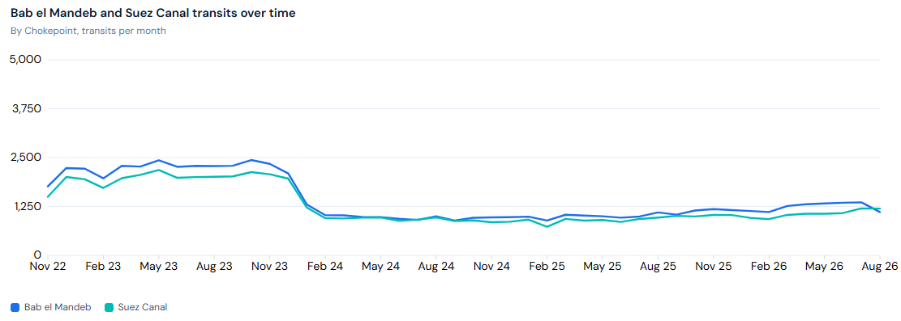
Source: Lloyd’s List Intelligence Red Sea Transit Monitor
Security summary
No attacks have been reported since 24 August when a Bahri-owned VLCC was hit by a projectile off Yanbu.
Shipping threat levels remain elevated due to Houthi attacks on vessels and maritime infrastructure. According to the Joint Maritime Information Center, the risk to commercial shipping remains substantial.
Risk outlook
July escalation in Red Sea tensions hit crude markets the hardest, but other segments cautiously continue business as usual, and plans to resume Bab el Mandeb transits have not been abandoned. Any changes in Houthi targeting or a further escalation would change the risk calculus, but the perception is that the Houthi threats are limited to a specific subset of Saudi-linked tonnage, rather than being a broad threat to the wider industry.
The renewed tensions in the Red Sea have had a limited impact on the wider shipping industry, with the market adjusting accordingly. As such, the Red Sea Brief will now be published every other week unless there is a change in circumstances.
If you missed our The Week in Maritime Intelligence webinar, register to watch the briefing on demand here
This brief was compiled by the Maritime Intelligence Unit
All analysis focuses on cargo-carrying vessels over 10,000 dwt.

.png)
